Thirty three years since it was premiered by English National Opera, Sir Harrison Birtwistle’s The Mark of Orpheus returns as the third instalment of the same company’s series of operas this season concerned with the myth of Orpheus. Judging from the reactions of the audience, the work has lost none of its power over that time to bemuse, intrigue, provoke, and exhilarate. It famously adopts a non-linear approach to the original myth in diffracting it in three versions, through the various episodes which intersect or overlap each other (rather than given in sequence) in their presentation of the three central figures – Orpheus, Eurydice, and the interloper Aristaeus – as mortal humans, as heroes, and as myth, rather as a Cubist painting or sculpture reveals different planes of an object at once.
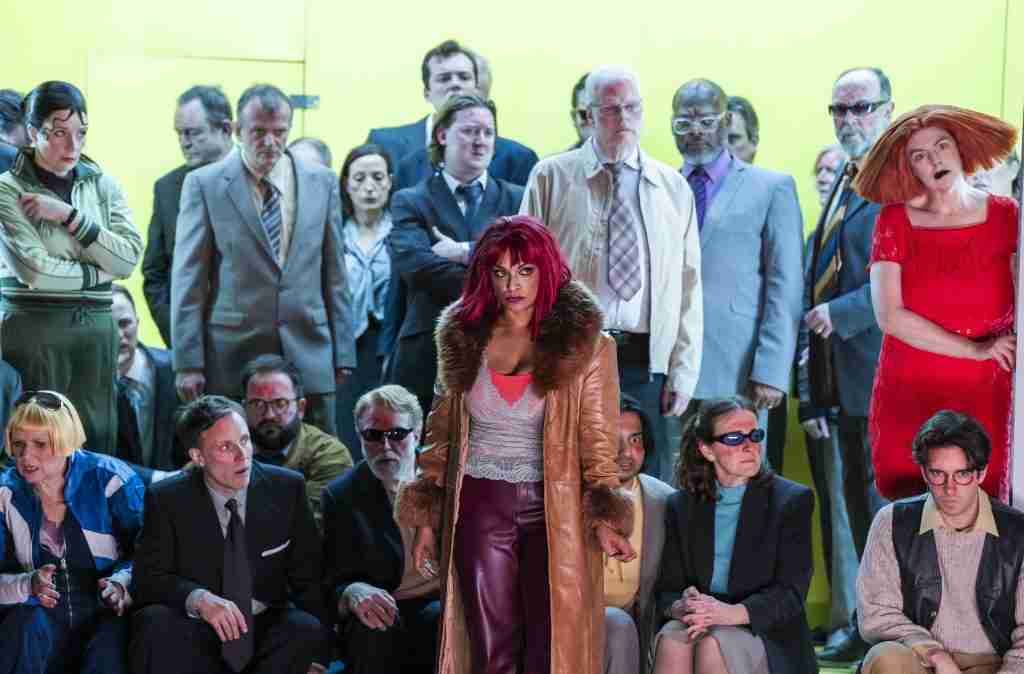
For all the choreographic virtuosity and exuberance of David Kramer’s new production – with Barnaby Booth’s contributions, and Daniel Lismore’s remarkable and memorable costumes – it presents those threefold dimensions in a rather muddled way. In failing to delineate them more clearly, the originality of Sir Harrison’s and his librettist Peter Zinovieff’s conception is rather obscured. Instead, the vividness of the staging and costumes – a fancy dress party – becomes the main event, in their kitsch and flashy manner (a crystal-encrusted skull, a la Damien Hirst appears at the end, representing the dead Orpheus, at least as the receptacle of historical memory), detracting from the opera’s engagement with the notion of memory and identity in the myth. As a result it takes on something of the ironic, satirical, or sardonic slant on metaphysics and myth as encountered in Ligeti’s Le Grand Macabre or Stockhausen’s Licht cycle, but the score and libretto suggest something more serious and earnest. While it is true that a composer or a producer may adapt a well-known story or myth because the audience can reasonably be assumed to be familiar with its bare outlines – the very reason that Peri, Caccini, and Monteverdi set the Orpheus story right at the outset of operatic history – the choreographic incoherence of this production does not squarely elucidate or develop the multi-faceted components of the composer’s vision, still less the original myth.
The interludes (or ‘passing clouds of abandon’ and ‘allegorical flowers of reason’ as they are styled) which reference other parallel myths dealing with love and loss (for example Venus and Adonis, and Apollo and Hyacinthus) are better handled in being enacted through dance and mime in a glass box which shifts across the stage at appropriate times, making suggestive points about the connection between sex, violence, and death. The non-musical part of Orpheus and Eurydice the Heroes are also lyrically realised as a circus or aerial act, with its often air-borne character creating a sense of corporeal freedom in counterpoint to their characters’ earth-bound and suffering forms, and the well-built figure of Matthew Smith certainly offers a heroic visual representation of Orpheus as a human.
Underpinning the busy stagecraft, Sir Harrison’s score remains one of the monuments of modern opera. Here it is masterfully interpreted by Martyn Brabbins as he integrates the shimmering, urgent colours executed by the live ENO orchestra playing in the Coliseum, with the pre-recorded electronic soundscape that is a more or less continuous sonic presence (a more felicitous parallel with Stockhausen, although it happens to have been created at the Parisian Institut de Recherche et Coordination Acoustique/Musique). Together with the singing on the stage, those three musical dimensions register here both as distinct in their own right, but also as absolutely essential to each other, just as three lines, jointly and severally, comprise a triangle (the figure of three is fundamental to the construction of this work).
Peter Hoare gives an outstanding performance as Orpheus the Man, characterising his unsettled and grief-wracked mortal nature with complete vocal conviction, in music that is often raw and jagged, but equally also blossoms into a Brittenesque melodiousness at times. Marta Fontanals-Simmons sings with a correspondingly plangent quality as his counterpart, Eurydice the Woman. Other singers are more discreetly committed to their roles which are rarely sustained vocally for long. Claron McFadden deserves particular credit for the shrieking excitability of her lines as Hecate (a shadowy deity of the underworld, represented here with an especially striking costume) like a post-Modern re-imagining of Baroque coloratura.
Despite the shortcomings of the production (which often enthral and infuriate in equal measure), the consistency and sincerity of the performance overall demonstrates that The Mask of Orpheus constitutes one of the major advances in the development of music drama as a Gesamtkunstwerk since Wagner. Whatever one thinks about the staging (and execution is certainly slick, even if the conception is not) indifference is surely the last response it would provoke in anyone.
Further performances to 13 November
www.eno.org
←
音乐会评论
英国国家歌剧院——哈里森·伯特威斯尔的《奥菲欧的面具》——彼得·霍尔、玛尔塔·丰塔纳尔斯-西蒙斯和詹姆斯·克莱弗顿主演;丹尼尔·克雷默执导;马丁·布拉宾斯指挥
Thirty three years since it was premiered by English National Opera, Sir Harrison Birtwistle’s The Mark of Orpheus returns as the third instalment of the same company’s series of operas this season concerned with the myth of Orpheus. Judging from the reactions of the audience, the work has lost none of its power over that time to bemuse, intrigue, provoke, and exhilarate. It famously adopts a non-linear approach to the original myth in diffracting it in three versions, through the various episodes which intersect or overlap each other (rather than given in sequence) in their presentation of the three central figures – Orpheus, Eurydice, and the interloper Aristaeus – as mortal humans, as heroes, and as myth, rather as a Cubist painting or sculpture reveals different planes of an object at once.