The likes of a traditional ballet gala are seen rarely on these shores; there are sometimes those by a company to celebrate some anniversary, but the bringing together of various international soloists for a single evening of dance is something that has fallen largely from favour. Ensemble Productions, a Russian promoter, continues to bring its Ballet Icons Gala generally once a year to the London Coliseum since its first such event in 2006; its galas give the opportunity for British balletomanes to see live some of ballet’s current stars from the world over; this year saw several Russian dancers (whom London does see courtesy of the Bolshoi and Mariinsky seasons at Covent Garden), but also some unfamiliar Italian artists, as well as some home-grown performers from national companies. Such events are, by their very nature, a mixed bag, invariably put on with minimum rehearsal and reliant on the dancers performing their tried and tested ‘party piece’. This year’s gala was somewhat different, however, with a fair smattering of contemporary work among the usual ‘warhorse’ pas de deux.
The big successes of the evening were, perhaps unexpectedly, the less well-known, contemporary works while the ‘big’ duets seemed to show a certain bland uniformity of style and attack; Gsovsky’s Grand Pas Classique felt very similar to The Sleeping Beauty Act Three Grand Pas, while little differentiated the Don Quixote and Le Corsaire pas de deux, except for the costumes. Nicoletta Manni, a principal with La Scala Ballet was, nevertheless, a sultry Kitri in the former, unfazed by the challenges this duet presents and exuding confidence and demonstrating a strong technique, while Iana Salenko in the latter was in sparkling technical form, tossing off countless fouetté turns and spins, but lacking stage persona. The same could be said of the men in both pas de deux who, their whizz-bang airborne pyrotechnics apart, were seriously short on personality. It was a pity that The Sleeping Beauty pas de deux was in Yuri Grigorovich’s musically inept and choreographically inert version, given the splendors of Bolshoi principals Ekaterina Krysanova and Artem Ovcharenko who nevertheless showed off their regal technique.
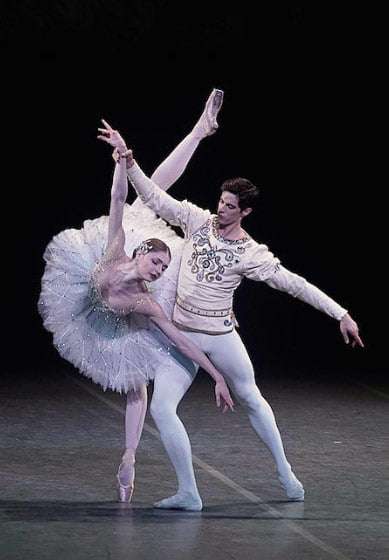
The Act Two Giselle pas de deux from The Royal Ballet production confirmed Yasmine Naghdi’s growing confidence and status as one of the company’s finest dancers; her wraith was truly from another world, her movements seamless, weightless. It was a pity, therefore, to see Marcelino Sambé essay Albrecht – the costume does not flatter his short stature, his partnering was tentative and his own dancing strangely muted. The Diamonds pas de deux from Balanchine’s Jewels triptych presented a somewhat mismatched Alyona Kovalyova from the Bolshoi and Briton Xander Parish from the Maryinsky. This duet calls for a real
porteur
in the man, and Parish was clearly not comfortable with the pairing with the admirable Kovalyova whose technique possesses a grandeur and expansiveness which befit her tall frame, but who seemed simply a little too big for him physically. Alberto Alonso’s 1967 Carmen Suite is now a period curiosity and made as a vehicle for the then reigning Bolshoi prima ballerina and
premier danseur
Maya Plisetskaya and Nikolai Fadeyechev. Maria Alexandrova did her best to deliver ‘Soviet sexy’ and Vladislav Lantratov manfully overcame the curiosity of his costume as Don José.
Two duds followed each other in the second half – the first an excerpt from Angelin Preljocaj’s tedious and empty duet from Le Parc, a waste of Mozart if ever there was one, and a waste of time for the sweet Italian pair who danced it, while Giuseppe Picone confirmed that he is not a choreographer in his own Elegie, sub-Glen Tetley tedium which nevertheless showed a young corps de ballet member Luisa Ieluzzi as a dancer of promise.
Better, but not best, Jason Kittelberger’s new duet Once with, performed by himself and Natalia Osipova. It is an inoffensive three-part duo of a couple in different moods with each other to Sibelius, although, despite moments of interest, it does not rise above the competent in terms of dance invention. A duet from Annabelle Lopez Ochoa’s Frida ballet did not bear being seen again so soon after Tamara Rojo’s appearance in it in the English national Ballet’s 70th-Anniversary Gala a few days before, despite Maia Makhateli as a spirited Frida.
Two modern duets emerged as the successes of the evening. In the first half, Lucía Lacarra deployed her limpid technique and boneless movement quality alongside a rejuvenated and arresting Matthew Golding in Finding Light. It is an intelligent and expressive reaction to the slow movement of Vivaldi’s Concerto in B major and served as a real showcase for these two dancers. Erina Takahashi and James Streeter from ENB appeared in a moving, even harrowing duo from Akram Khan’s First World War work Dust; encapsulated in this duet is the effects upon the soldiers of the conflict and their spouses, often left with a broken man. Takahashi and Streeter are superlative artists who, to Jocelyn Pook’s resonant score and the sound of a Tommy singing a marching song, created a whole world of movement and meaning. These two very different dances were the unexpected hits of the evening and may just indicate that ballet galas today are perhaps no longer what they have been for so long – programmers take note.
←
音乐会评论
伦敦大剧院的Ensemble Productions演出——芭蕾舞偶像盛典
The likes of a traditional ballet gala are seen rarely on these shores; there are sometimes those by a company to celebrate some anniversary, but the bringing together of various international soloists for a single evening of dance is something that has fallen largely from favour. Ensemble Productions, a Russian promoter, continues to bring its Ballet Icons Gala generally once a year to the London Coliseum since its first such event in 2006; its galas give the opportunity for British balletomanes to see live some of ballet’s current stars from the world over; this year saw several Russian dancers (whom London does see courtesy of the Bolshoi and Mariinsky seasons at Covent Garden), but also some unfamiliar Italian artists, as well as some home-grown performers from national companies. Such events are, by their very nature, a mixed bag, invariably put on with minimum rehearsal and reliant on the dancers performing their tried and tested ‘party piece’. This year’s gala was somewhat different, however, with a fair smattering of contemporary work among the usual ‘warhorse’ pas de deux.