This third and last of The Royal Ballet’s mixed bills this season promised much and delivered considerably less. What seemed on paper as an exciting mix of works proved to be a stodgy combination which served to confirm, if further confirmation were still needed, that the construction of coherent and stimulating evenings of dance are not one of the strengths of the current Royal Ballet management. To end with the final act of Petipa’s
The Sleeping Beauty
, the company’s choreographic touchstone, would indicate a programme of substance, but, with a lightweight opening work and an indigestible hotch-potch of five
pas de deux
in between, it proved out of context and thereby considerably lessened.
Valentino Zucchetti is a much-liked company First Soloist who in recent years has also turned his hand to choreography. To his credit, he is a dance-maker fully within The Royal Ballet tradition with a penchant for clear, lyrical movement and an undeniable ability to populate the stage intelligently. He has worked on several occasions with The Royal Ballet School and
Anemoi
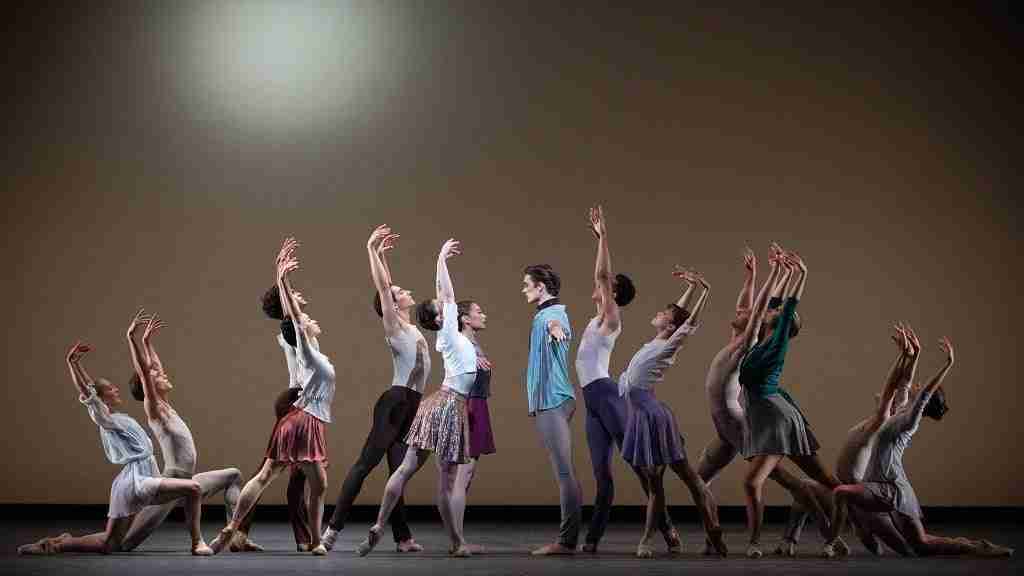
, named after the wind gods of Greek mythology, is his first creation for the main Covent Garden stage, is an extension of that; this is a work for the younger members of the ensemble who bring bright-eyed vigour to their endeavours while not really ever getting under the skin of what they are doing. The choice of music did not help, Zucchetti has chosen chunks of seriously episodic Rachmaninov and has no option but to keep bringing dancers on and off, cutting them short just when they seem to be getting going.
There are some groupings which please the eye but all too often it becomes something of a blur, dancers darting hither and yon. The third section is in essence an extended
pas de deux
, here danced by Mariko Sasaki and Lukas Bjørneboe Brændsrød who did not quite achieve the seamless quality needed for such concentrated duet work. It was a nice touch at one moment to have four further couples silhouetted at the back behind them, but strange that their movements did not echo those of the main couple. The heterogenous costuming was bizarre, something of a Primark supermarket sweep, and did nothing either for the dancers or the ballet as a whole; it is a pity that
Anemoi
was presented without any form of backcloth or setting which may have served to anchor the whole enterprise. Zucchetti is to be encouraged – he is a real company dancer who understands ballet from the inside – but more focus needs to be brought to the stage.
A lack of focus and logic after first interval characterised the long middle section of five duets. These
divertissements
were originally billed as a celebration during The Royal Ballet’s ninetieth anniversary year of what and who have made the company great; what it has become is a random grouping of pieces some of which with little or no link to the ensemble. The glory of Wayne McGregor’s
Morgen
was, unsurprisingly, the music, perhaps the most ravishing of Richard Strauss’s songs here sumptuously performed by ex-Jette Parker Young Artist soprano Sarah-Jane Lewis. McGregor’s 2020 lockdown duet is intensely lyrical, especially for the woman, here danced with grace and fluidity by Yasmine Naghdi, while Joseph Sissens twitched and flicked in full McGregor mode.
To follow this with the ‘Farewell’
pas de deux
from MacMillan’s
Winter Dreams
lacked any sense, and neither piece benefitted from the juxtaposition. Alas, Marianela Nuñez was an absent Masha, beautifully danced (she cannot do otherwise) but projecting next to nothing of the character and anguish of this woman who is about to bid farewell to her lover. Vadim Muntagirov attempted to enliven the moment and tossed his locks with abandon, but he cuts a slight figure in a role created for the great Irek Mukhamedov. One saw the joins in this duet, which can never be the intention.
Another pas de deux set to piano came after, Wheeldon’s
After the Rain
which, it must be noted, was created for New York City Ballet in 2005, so hardly a celebration of The Royal Ballet’s history. Federico Bonelli and Fumi Kaneko executed the slo-mo choreography with considerable aplomb without quite achieving the near-transcendental quality this duet can acquire.
Quite why a piece by the Swedish Mats Ek then appeared in this collection of duets is unfathomable; he simply has no link with the company. In 2016, Ek announced his retirement and the withdrawal of all his works from performance, so it is a matter of some considerable disappointment that he has reneged on his promise and carried on, creating
woman with water
for Royal Swedish Ballet only last year. Now, for no discernible reason, here it was at Covent Garden, a surreal nonsense – how irritating is that lower-case title? – featuring Natalia Osipova in an outsize neon orange frock, a vaguely puzzled Marcelino Sambé, a green table and glass of water. As this farrago trundled on, displaying the whole panoply of Ek’s brand of eurotrash dance, one mused on its meaning – was Osipova’s gulping down of a whole glass of water supposed to be an exhortation to us all to keep hydrated and was her final collapse into a crumpled heap (and her being ‘swept’ off the stage by Sambé with an outsize broom) a dire warning of the consequences of dancing this tosh? Either way, it was a crashing bore, a criminal waste of talent and a loud raspberry (or worse) to the company’s illustrious history.
More worrying even, Ashton’s joyous
Voices of Spring
, which was danced with too little sense of style and not a few fumbles. Can The Royal Ballet not now perform work by its own Founder Choreographer to the requisite standard? One simply cannot blame the dancers; they dance so little Ashton now that it is no surprise that considerable technical demands masked by the impression of insouciant ease which are the choreographer’s hallmark prove too much. It made for a concerning close to the second part of the evening.
Matters did not improve noticeably with a pared-back Act III of
The Sleeping Beauty
, courtiers, attendants and fairies all excised. Its grandiosity and extravagant costuming looked faintly preposterous after the plain presentation of the preceding works; Act III is the culmination of this most glorious of ballets and without anything prior to lead the audience up to it, it was a visual and stylistic shock. It has been a long, long time since the dancers of the company have had to show themselves in purely classical movement, and
The Sleeping Beauty
is a ballet where there is no place to hide. What emerged was a careful, almost anxious approach to the choreography, many dancers seemingly overawed by its demands, the attention given to ‘getting it right’ draining the movement of both brilliance and meaning. Some exceptions were welcome: Isabella Gasparini as one of Florestan’s two sisters simply sparkled in her choreography, she was fleet of foot and expressive in her
épaulement
; Mayara Magri made for an almost voluptuous Princess Florine, displaying fine musicality and a sense of phrasing while Alexander Campbell was adept in portraying The Prince with a regal bearing, pleasing footwork and a fine sense of placement. Elsewhere, much of the dancing while ‘correct’ lacked the grace notes which make Petipa’s movements so satisfying. Character dancing has coarsened which made the Puss-in-Boots and Red Riding Hood duets less than effective.
Overall, the company’s classicism is at present a little out of focus, but then, apart from
Beauty
, none of the works presented during these past two and half months has been rigorously classical (indeed some have been aggressively anti-classical) and the dancers are simply not used to it. Quite where that leaves the artists is open to debate – next season, they will not get a chance to dance in a classical ballet (
The Nutcracker
,
Giselle
being in essence a Romantic work) until November, precisely a year since they last did so.
Star ratings:
Anemoi
★★★☆☆
Divertissements
★★☆☆☆
The Sleeping Beauty Act III
★★★☆☆
←
音乐会评论
英国皇家芭蕾舞团——《美丽》综合演出——《风神》;《晨曦》;《冬日之梦》;《雨后》;《持水女子》;《春之声》;《睡美人》
This third and last of The Royal Ballet’s mixed bills this season promised much and delivered considerably less. What seemed on paper as an exciting mix of works proved to be a stodgy combination which served to confirm, if further confirmation were still needed, that the construction of coherent and stimulating evenings of dance are not one of the strengths of the current Royal Ballet management. To end with the final act of Petipa’s