Richard Jones’s
Ring
for English National Opera began last year, for no apparent reason with the cycle’s second instalment,
The Valkyrie
, and with its intended circle of fire at its climax infamously thwarted because of safety regulations, proving rather prophetic of a production that rather failed to catch fire or cast much light on that work. The presentation now of the cycle’s ‘preliminary evening’,
The Rhinegold
, is somewhat more successful, within its own terms and ideas at least, even though it doesn’t really draw any connections with or illuminate the banality of what was seen in
The Valkyrie
, nor explain why that came first. With Arts Council cuts threatening the very life of ENO, this
Ring
seems as cursed as the jewel within the drama itself, fated perhaps not to be completed and with themes left unexplored or unexplained.
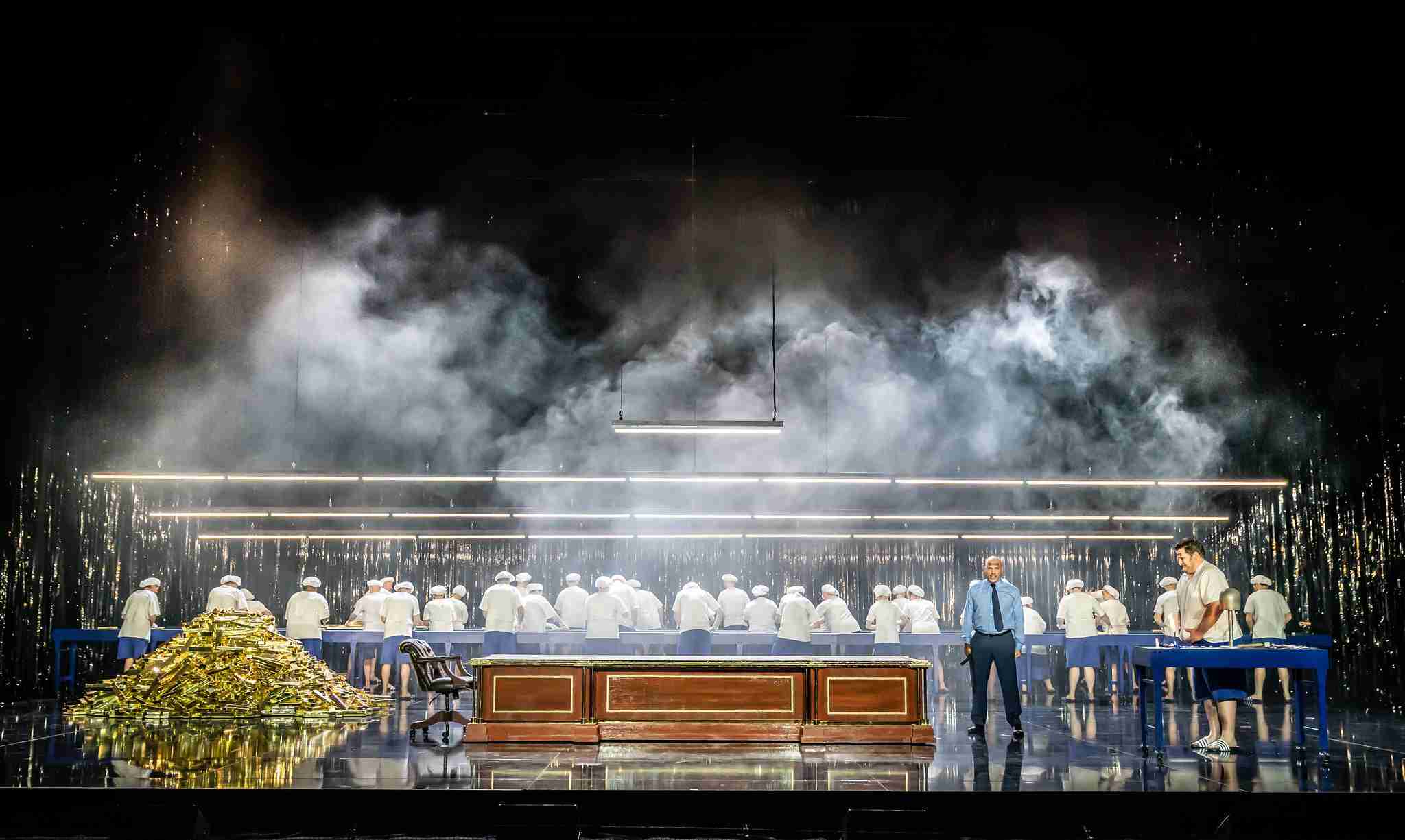
Some of what is good or telling in this instalment falls outside of the sung drama and instead either at the outset or during the interludes between the scenes. Before the music starts, a fallen chunk of a tree is seen, eventually dragged away by a naked man; then another, smaller part of a trunk is removed by a semi-naked man; a smaller twig still is picked up by somebody more fully dressed, and finally a besuited Wotan appears with his spear into which the wood has presumably been turned, demonstrating that the ascent by man to a ‘civilised’ legal order in society has been achieved by the spoliation of nature. Between the first two scenes, Alberich (‘Dark Alberich’ to Wotan’s ‘Light Alberich’ it will be remembered) is seen in a similar sequence, paring down the gold he has seized from the Rhine into smaller lumps, until he has his all-powerful ring. Seeing that it is only later in the cycle that we explicitly learn about Wotan’s sacrifice of an eye at, and the removal of a branch from, the World Ash Tree, it makes sense to draw out the parallels between how they each gained their power. Similarly, it is not unreasonable that the Norns are also introduced here at the beginning of the cycle (where otherwise they wouldn’t appear until the opening of
Twilight of the Gods
) as black-gowned schoolgirls, initially at the end of the second scene, and then before the fourth to awaken the sleeping Erda (perhaps prefiguring Siegfried’s arousing of Brünnhilde?).
It is less clear, however, what Jones means by presenting the Rhinegold as a golden baby marionette, manipulated by sinisterly anonymous, black-clad figures, who themselves had earlier shadowed the Rhinemaidens, and also seem to hinder and then aid Alberich in his grasp of the golden baby. Given that, in his
Ring
for the Royal Opera House, Jones explored the strand of Ludwig Feuerbach’s theological philosophy that runs through the work by depicting the mythological ossification of what the deities represent as statuesque idols at the conclusion of the cycle, which are consigned to the flames as the symbol of mankind ridding itself of religious superstition, it is tempting to think that perhaps here, at the outset of his new
Ring
, he means to return to that theme in some sense, by depicting this valorisation of the human reproductive process – something that would occur lovingly and naturally for Alberich the dwarf if one of the Rhinemaidens (pointedly denoted as “Rhine-daughters”) had given in to his amorous advances. As he rejects human love and emotions, instead he melts down the golden baby into the brute, materialised form that suits him, enabling him to enslave and dehumanise his fellow Nibelungs in turn, as though inanimate objects. His sadistic nature is also played out firmly, to the point of what would be a caricature of a James Bond villain.
Any comment upon the procreative urge, or the perversion of it, is perhaps developed when Alberich is first shown using the power of the Tarnhelm: rather than becoming invisible (as in the original scenario) instead he is multiply-cloned so that he can go among the toiling Nibelungs and whip many of them at once. Within this context of reproduction, it is just possible too that the unexpected early appearance of the Norns – being the daughters of Erda – in this part of the
Ring
makes sense. The theme also takes on some darker potency when bearing in mind the fact (noted by Susan Sontag I think) that so few of Wagner’s human heroes have children, and so generation, within the
Ring
here at least, would appear to occur only among other sorts of beings (even Siegfried is the product of the unusual, even unnatural, union between brother and sister).
Whatever idea is intended by the golden baby is not explicitly developed (at any rate not yet – one of the excitements of any new
Ring
is what will happen in subsequent instalments, but here we have the frustration of awaiting the last two instalments in successive years; if they ever come at all). It is surely only coincidence that Bayreuth’s
Ring
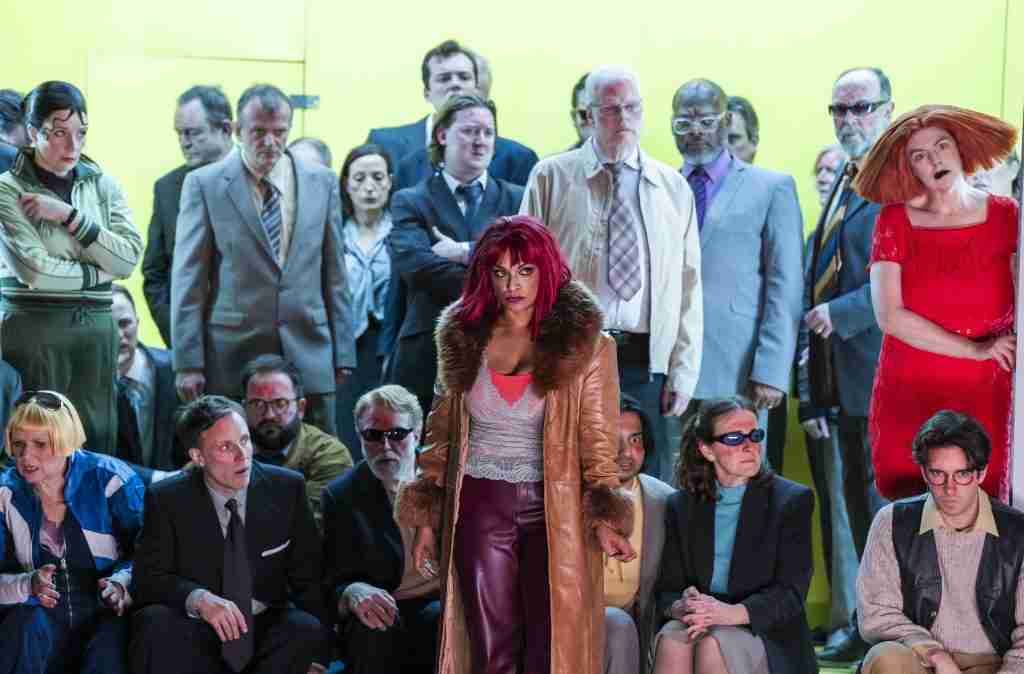
last year explored the subject of child abuse and childhood trauma – there is no such psychological approach to the states of infancy and childhood here. Like much else in the production, the suspicion arises that it is theatrical kitsch, designed to play to the gallery: for example Alberich’s dressing up in what is really no more than a fancy-dress dragon-suit when he demonstrates the power of the Tarnhelm, or his substitution by a colourful stuffed toy frog to show how small he can become; or Fafner’s reversing a lorry to collect the gold hoard. Kitsch certainly seems to be a grounding vision of this production and would explain the shimmering tinsel strips around the three sides of the set throughout, as though the whole drama is something in the nature of a cabaret. Not only are the Rhinemaidens dressed in what are essentially full swimsuits, the gods appear as a rather rum group – Fricka in a long canary-yellow dress, Freia in a Cath Kidston flowery one, and Donner in a tracksuit. But, however striking such visual ideas appear as spectacle – not least the shiny ticker tape streaming down in bands, of course in rainbow colours, for the bridge to Valhalla – they don’t cohere as any overarching satirical interpretation of the work. Frank Castorf’s ingenious ironising of the whole
Ring
for Bayreuth set the bar high in this respect, and this kitschy slant on it comes nowhere near that in complexity or insight.
Musically, standards are far better honed and consistent, above all ENO music director Martyn Brabbins’s excellent control of the score – as probably the longest continuous pieces of music in existence (that doesn’t consist of repetition or drones, except in its opening four minutes) such an achievement can hardly be overestimated. Brabbins sustains the tension of the music without hurrying but also carefully bringing out much instrumental detail in a balanced manner. Although John Relyea is somewhat gravelly in tone with not all notes clearly delineated, his singing does otherwise exude calm god-like authority as Wotan. If Madeleine Shaw is a touch squally as Fricka she is nevertheless incisive, where Katie Lowe’s Freia is tender and unassuming in the little music given to her. Blake Denson projects the part of Donner powerfully, while Julian Hubbard is an excitable Froh. Frederick Ballentine aptly conveys Loge’s mercurial nature and repartee, with singing bright and agile on the whole, but there is a tendency to swoop a little between notes and his American accent gives the role an unfortunate effect of belonging to a comic musical rather than Wagner. Christine Rice arrestingly conveys the otherworldly voice of Erda, imparting wisdom to Wotan.
Leigh Melrose gives a virtuosic account of Alberich, almost growling at first and especially when he confronts Mime and the Nibelung slaves, but expressive elsewhere, particularly in his later monologue as he curses the ring. If the role’s villainy is overplayed, Melrose certainly cannot be blamed for fulfilling so compellingly the remit given to him. Likewise, John Findon makes the most of Mime, whinnying and whining, but also finding the music in the part. Eleanor Dennis, Idunnu Münch and Katie Stevenson sing out vividly and crisply as the Rhinemaidens, both individually and in ensemble. By no means least, Simon Bailey and James Creswell are eloquently communicative in their musical lines as Fasolt and Fafner – paradoxically so for the numbskull giants they portray.
All singers enunciate clearly John Deathridge’s very serviceable English translation. It avoids carrying over the archaising language of the German in which Wagner wrote the original text and preserved in some measure by previous translations. But neither is it trite or colloquial – it maintains its own poetry in a comprehensible, contemporary register, and uses its own alliterations, onomatopoeias and internal rhymes as Wagner’s does. If this
Rhinegold
disappoints by not grappling with grand themes, some will find it an approachable and perhaps even comically engaging presentation. But more still will appreciate its musical and textual achievements, and it should be heard if only for those reasons.
Further performances to March 10
←
音乐会评论
照片:马克·布伦纳
Richard Jones’s