Ravel’s
L’enfant et les sortilèges
(1925) is usually paired with his other one Act opera,
L’heure espagnole
. But in the Royal College of Music Opera Studio’s double bill this spring, directed by Liam Steel, it is intriguingly juxtaposed with Respighi’s rarely seen version of the Sleeping Beauty story,
La bella dormente nel bosco
, and so is a very welcome project if for that reason alone.
However, deeper and telling connections and inversions between the two operas are ingeniously made. Both narratives are populated by an array of non-human creatures and objects, in each case bringing to life a wonderful fantasy world that has as much to tell adults as children. In Respighi’s delightfully wacky retelling, the Princess is fated to sleep not for one hundred years, but for no less than three hundred, and so wakes up in the 20th century – in other words, let us say the present, rather than a mere indeterminate century on from whichever distant time in which the classic literary elaborations by Basile, Perrault or the Brothers Grimm may be taken to be set. The dissonant chords which close Respighi’s score suggest that, rather than a happy ending, the Princess awakens to uncertainty and trouble, emphasised by Steel here in that the Princess looks positively peeved to be roused by the Prince, not overjoyed. And she is assisted or manipulated into action by assistants as though she is a marionette – having been one of only two or three singers in this production not shadowing an actual marionette (Respighi’s first version of the opera in 1922 was written for a cast of marionettes, but with the singers in the pit, so Steel brings the latter into greater prominence.)
That uncertain world to which the Princess awakens is then seemingly, and aptly, characterised at the beginning of Ravel’s opera here, as the Child’s father menacingly cracks a belt as a threat of punishment to his recalcitrant son. In the kerfuffle that follows in Part Two as the climax of the drama, the animals which the Child has aggravated – including the father, now in animal guise – gang up and beat him with their belts. Rather than causing concern to everybody on falling unconscious as with the Princess, the Child’s inert form is now a cause of satisfaction to the bystanders – it is not so much his compassionate care for the squirrel’s injury (which largely goes unnoticed here) but his violent pacification which incites them to remark that now “this is a good boy”, being presumed to have learnt humility through his punishment. The King and Queen from Respighi’s scenario reappear at this part in the Ravel, over the unconscious Child, resolving their loss of the Princess in that earlier work and the uncertainty into which the Princess stirred, by the Child’s coming round and falling into the protective arms of ‘Maman’, duly chastened.
Visually and choreographically the two productions are equally deft. In the gloomy woods of
La bella dormente
, the marionettes are discreetly and meticulously wielded, above all the fairies with their white-veiled forms illumined by LED lights from within their bodies.
L’enfant
is even more dextrously handled – the Child’s schoolroom is seen as a narrow garret, under the eaves of a house and bounded by black darkness on all sides, and skylights in the roof opening the view to the eerie full moon above. Within that claustrophobic world, the various objects the Child has upset or destroyed neatly slither into life from within the doors, walls, floors, cupboard, fireplace, clock or desk. The house recedes into perspective in the transition between the opera’s two Parts, before opening up to bring us back to the nocturnal woodland of
La bella dormente
for the showdown between the Child and the animals.
The sizeable cast give generally characterful accounts of each work which both call for a varied range of musical personalities. Lylis O’Hara is a full-voiced, proud Princess for the Respighi, making a suitable, regal contrast with the more whimsically agile
coloratura
of Seonwoo Lee and Ceferina Penny’s Blue and Green Fairies respectively. Jamie Woollard has a deep, broad tone as the King, if somewhat hollow and dry, and Lexie Moon’s clear register makes for an eloquent, surprisingly youthful-sounding Old Woman, with whom the Princess spins wool and so pricks her finger in fulfilment of the prophecy about her. Nathan Breeze is a bluff Woodcutter, who relates the story about the Princess to Dafydd Jones’s lyrically contained Prince, three hundred years later.
If Respighi’s eclectic score doesn’t quite have the sparkle of Tchaikovsky’s ballet on the same subject, then Michael Rosewell’s interpretation with the RCM Orchestra carefully and thoughtfully paces its evocations of the woodland, calling to mind perhaps the similar music of Dvořák’s tone poems or Janáček in
The Cunning Little Vixen
, rather than the more grandiose textures of his own famous tone poems like an Italian Richard Strauss. Instead of dramatic tension, the work tends to unfold with a reflective lyricism or even a Wagnerian brooding in the unfurling of some melodies, drooping ominously in the bass sections of the orchestra.
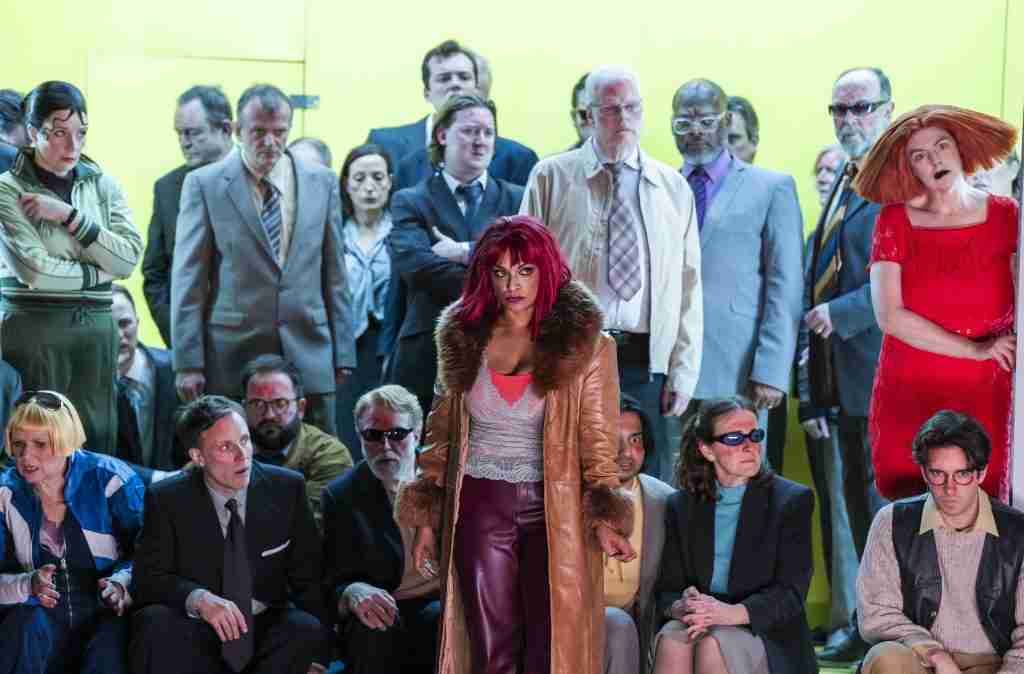
In the Ravel, a pungently whining dialogue among the oboes and double bass harmonics at the opening aptly depicts the Child’s carping about his homework, before giving way to a vivid performance of notable alacrity as the different objects alarmingly come alive. If anything, it is the Respighi which comes across with subtler hues of French musical Impressionism, than this edgier account of the Ravel, calling to mind here Stravinsky, perhaps, in the vibrant timbres coaxed from the orchestra. The singers are also on lively form, led by Moon as a more deliberating, glossy-toned Child than maliciously snarling or wilful. Charismatic performances from Jamie Woollard’s Armchair and Daniel Barrett’s Grandfather Clock are followed by yet brighter accounts of the Fire (with billowing dress like the famous image of Marilyn Monroe) by Sofia Kirwan-Baez and the Princess (separate from Respighi’s sleeping beauty) by Misato Makiyama; and an amusingly hectoring, shrill lesson from Sam Harris as The Arithmetic. Daniel Barrett and Phoebe Rayner give a slyly erotic, almost wordless rendition of the Cats’ dialogue, introducing the Child to one of the other facts of life, before the confrontation with the angry animals, musically well-articulated in chorus together.
Steel rightly asks the audience to ‘reconnect with your inner child’ and reminds us that ‘the overriding intention of the creators of these operas was primarily to entertain’. That certainly happens here; but these resourceful productions and performances offer more than that, providing much stimulation for adult sensibilities too.
Further performances to March 18 with alternate casts
←
音乐会评论
《睡美人》——三幕歌剧,由吉安·比斯托尔菲根据夏尔·佩罗的童话故事《睡美人》改编的剧本[意大利语演唱,配有英文字幕]
Ravel’s
![《睡美人》——三幕歌剧,由吉安·比斯托尔菲根据夏尔·佩罗的童话故事《睡美人》改编的剧本[意大利语演唱,配有英文字幕]](https://oss.lpscj.com/image/20260419/classicalsource/443/cover_69f33c6795de97ad.jpg)