If Debussy’s
Pelléas et Mélisande
was the antithetical response of one French composer to the influence of Wagner – and
Parsifal
in particular – Fauré’s yet later
Pénélope
(1913) was another. Just as Debussy’s opera disavows much sense of heroism or transcendence, so does Fauré’s work turn its perspective away from the central figure of Odysseus (Ulysse) in one of the seminal works of Classical literature and towards his abiding wife, Penelope. As a model of patient, female virtue, she is no less an archetype in European culture, represented in art, sculpture, literature and music, for her heroic, chaste waiting for Ulysse’s return during the course of twenty years, while he was away at the Trojan War and then caught up in his wanderings back to Ithaca.
In Munich the legacy of Classical Greece weighs particularly heavily with the monumental architecture of the Königsplatz, whose two museums are notable repositories of Classical art (the Glypothek in particular) as well as with the Bavarian kingdom’s connection with the foundation of the modern state of Greece in the 19
th
century. Andrea Breth’s production masterfully and sympathetically adopts a more inquiring stance in relation to the received notions of the legend of Penelope as an exemplar of womanly saintliness, in exploring the
ennui
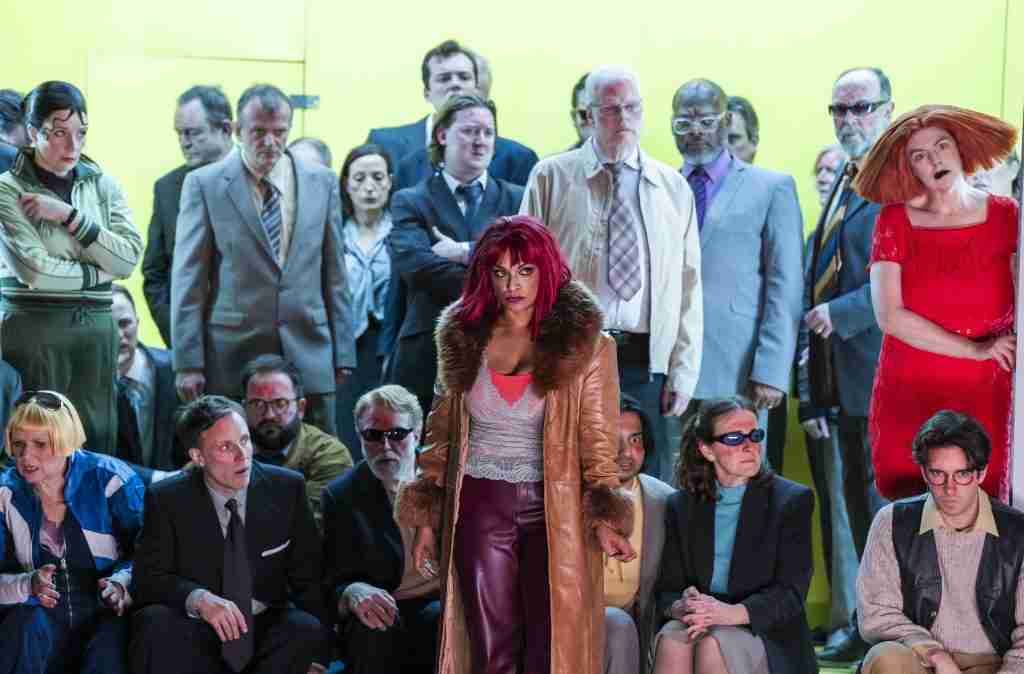
of her long waiting instead. Breth downplays any sense of expectation or drama by slowing down the action on stage to what looks like a fatigued ritual played out with dull inevitability as Penelope sits at home, attending to the tedium of everyday domestic chores. The more heroic narrative promoted by the original legend and the Classical statues dotted around the set is ironised by that focus on the far less glamorous background to Penelope’s eventual triumph, and further in the suitors’ aspiration to greatness by posing as those statues, and in the doublings of Penelope and Odysseus as their older selves, who view that sculpture as museum exhibits and therefore the heroic story of their Classical counterparts as a received myth rather than lived reality. At other times those doublings are elusive or enigmatic, but that seems to be part and parcel of a production that tends to eschew overt action or behaviour, or any obvious narrative of redemption, almost an echo of
Waiting for Godot
.
Paradoxically the decelerated action makes for a more dynamic conception of this opera whose premise about waiting seems an unpromising subject for a drama. The different layers of time implied in the choreography also contribute to that – the Classical past versus the present, the different phases of Penelope and Odysseus’s domestic life, the appearance of a further double for the latter as a boy when the nurse Euryclea recognises Ulysse on his return, and so recalling the infant she helped to bring up. Despite the apparent circularity and monotony played out on stage, a climax is still achieved and Penelope’s vindication is brought to the fore as it is a female archer who launches a triumphant arrow from the bow rather than Odysseus. No less suggestive is the seeming abuse the suitors mete out to Euryclea, eventually turned against them when they are slaughtered on Odysseus’s return, not graphically enacted here but presaged by the butchered carcases suspended in a cold room, presumably ready for a feast.
Subtle and generally restrained accounts from both Victoria Karkacheva and Brandon Jovanovich as Penelope and Ulysse compellingly sustain the subdued spirit of this production, but still cohere with the lyrical strain of Fauré’s score, often proceeding as an outpouring of the compositional style of his
mélodies
rather than the terser, recitative character of Debussy’s opera for example. Rinat Shaham conveys the quiet, sombre voice of experience as the nurse and old retainer Euryclée with a probing account of the music. As the shepherd Eumée in whom Pénélope confides, Thomas Mole is enigmatically indifferent and inscrutable, but becomes excitable on Ulysse’s return, marking a turning point in the drama. If Pénélope’s five maidens are lightly playful here, the handful of suitors evince more serious purpose, though with some radiant allure from Loïc Félix’s Antinoüs and Zachary Rioux’s Ctésippe.
The veiled performance of the music by Susanna Mälkki and the Bavarian State Orchestra underlines the sense of ritual. The phrasing and structure of the music is perhaps more squared off, and the timbre a touch bolder and direct, than the more flexible and quintessentially French accent of the notable Erato recording by Charles Dutoit and the Orchestre Philharmonique de Monte-Carlo. Despite that, and the fact of almost incessant waiting in the drama, there is undoubtedly a haunting sense of direction and flow in Mälkki’s interpretation which attentively brings out the score’s unique beauty. A somewhat unconventional opera for its lack of action – arguably more an oratorio – it is probably surprising that it is not often staged. But, on the basis of this performance and production, it deserves to be brought into greater prominence.
←
音乐会评论
《佩内洛普》——三幕歌剧,由勒内·福舒瓦根据荷马史诗《奥德赛》改编剧本 [法语演唱,配有德语和英语字幕]
If Debussy’s
![《佩内洛普》——三幕歌剧,由勒内·福舒瓦根据荷马史诗《奥德赛》改编剧本 [法语演唱,配有德语和英语字幕]](https://oss.lpscj.com/image/20260419/classicalsource/38/cover_a532fd2ccf93957b.jpg)