Staging a long, serious opera such as
Zelmira
(1822) based on myth and ancient history presents quite a challenge on its own terms, to keep an audience engaged with its plot twists and extensive arias. Adding to those complications in this new production for Pesaro’s Rossini Opera Festival is Calixto Bieito’s decision to stage the work in the round in the former basketball arena of the Auditorium Scavolini, without the ability to deploy any elaborate set or for the singers to avoid audience scrutiny from any angle. (A normal stage with wings was erected at end of the hall in the same venue last year for
Ermione
so, evidently, it is possible.)
The narrative concerns Zelmira’s actions to save her elderly father, Polidoro, and the island he rules, Lesbos, from conquest – by Azorre first, and then by Antenore who has already had Azorre killed before the opera starts. Zelmira has hidden Polidoro away in a mausoleum for safety, but Antenore exploits this fact to try and secure the throne of Lesbos by accusing her of having despatched both her father and Azorre, which even her confidant Emma and her husband Ilo believe temporarily, the latter on returning from defending his own homeland from attack.
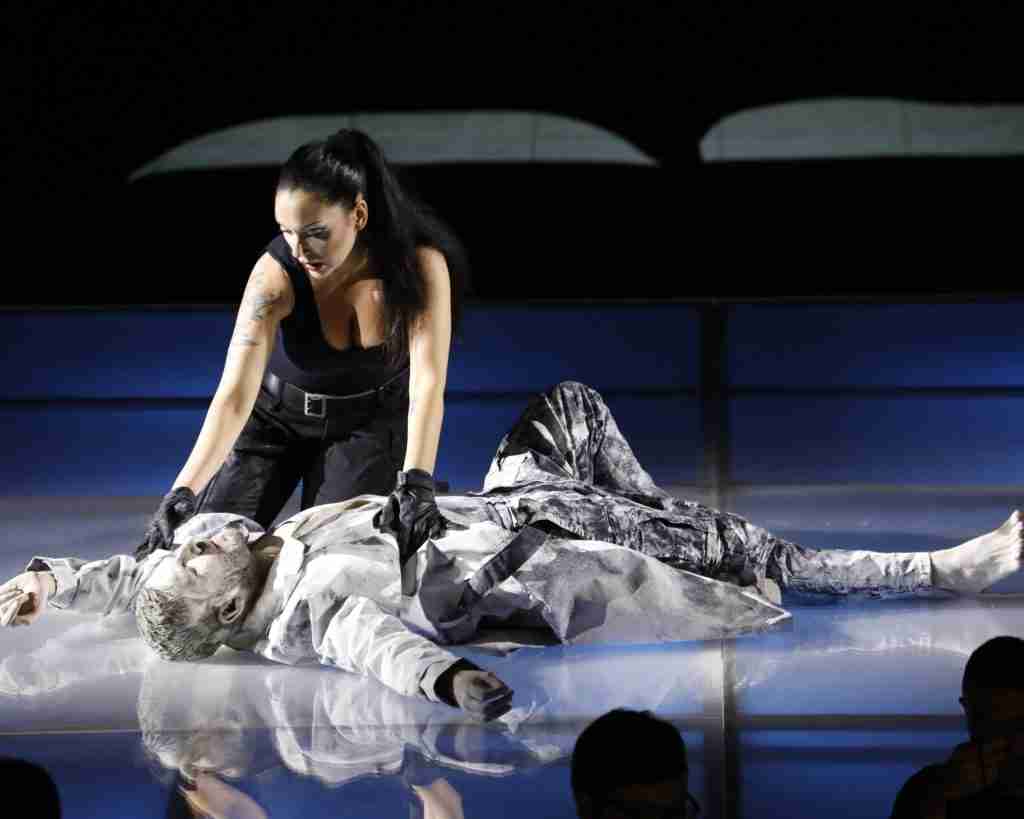
Bieito has the drama take place on a long dais of illuminated perspex squares, paradoxically up in the open despite Polidoro’s being confined in the depths of the mausoleum for some of the scenes. There are a few sunken recesses, like graves, and indeed it is from one of these that the dead Azorre is unceremoniously dragged out of its soil by Antenore and his general Leucippo. Brought into some sort of action, if not exactly to life, Azorre subsequently remains on the scene as a silent extra, haunting it like a figure of death, implicitly but grimly mocking the intentions and aspirations of the characters on stage, for example when gathering up the helmets of the war dead as though to point out the futility of battle, and when bringing on an olive tree when peace beckons. Just as significant are two other unspeaking characters – a winged angel who periodically appears among the audience to observe the action, a serene counterweight to Azorre’s deathly presence; and the young son of Zelmira and Ilo, a pawn in the midst of all this and the heir to an uncertain future, who is pointedly ignored by his parents but entertained more coaxingly by Emma, Antenore, and Azorre.
Stage action among the singing protagonists often deepens or ironises the narrative, but also is often both allusive and elusive. To some extent that is perhaps only unintentionally since the lack of any surtitles prevents precise understanding of what is being said at any given time. The tape projector brought on by Leucippo and which Emma then laboriously unwinds suggests that there is some evidence which he has on her or Zelmira, or perhaps that he has some other amorous designs on one of them. Leucippo’s psychological and homoerotic hold over the nervous, troubled Antenore is clear (especially with Gianluca Margheri’s muscular torso on display throughout much of the performance) as well as Leucippo’s mastery over events, manifested in his yielding to defeat and drowning himself in the pool of water in another recess on stage. If the constant shifting around of the characters is sometimes distracting, it does convey something of the tactical moves of figures over the squares of a chessboard, with the sense of inevitability and ritual played out.
Having participated in the previous two annual festivals at Pesaro, Anastasia Bartoli reveals herself again as a highly accomplished Rossinian soprano, capable of pinpoint agility throughout her range and solid tone in the title role. Marina Viotti complements her superbly as Emma, almost a vocal dead-ringer but somewhat richer in timbre. They blend stunningly for the duet in which Zelmira entrusts her son to her, with a simple accompaniment of cor anglais and harp alone.
Enea Scala successfully captures Antenore’s insecurity with articulate singing that carries some heft lower down but soars into a lighter-voiced timbre higher up, while Leucippo’s menacing control and authority over him is expressed by Margheri’s quiet, firm confidence in vocal register. Lawrence Brownlee is a more effusive tenor than Scala as Ilo, where notes sometimes sprawl, though he’s certainly in command of the role’s sizeable vocal range, if stretched in higher passages. Marko Mimica sings warmly as the physically ashen Polidoro.
Giacomo Sagripanti presides over a measured but gripping account of the score, which gives the music space to breathe over its lengthy spans. The Orchestra of the Teatro Communale di Bologna are immersed in the very centre of the stage, as though the drama emanates from the autonomous music, rather than the other way around, elevating the status of a magnificent
opera seria
by Rossini that ought to be better known. Sagripanti controls the expansive, difficult acoustic of the Auditorium with clear phrasing but rich sonorities from the orchestra, as also from the Chorus of the Teatro Ventidio Basso, who come on from the sides of the hall, in between the audience, adding dramatic impetus and musical energy. The off-stage band appears high up in what was presumably once the commentator’s box, adding to the all-round experience.
If Bieito’s vision of the work is sometimes obscure, it’s never less than suggestive and thought-provoking, hardly warranting the mindless boos of disapprobation from some sections in the audience. There’s never the sense of effects without cause, or gratuitous action in a long opera whose staging could be difficult to fill up meaningfully.
←
音乐会评论
关于此网页
Staging a long, serious opera such as