As the programme notes for Victoria Newlyn’s production of this double bill of Respighi stage works points out, neither of these works were originally created as conventional operas. His version of the sleeping beauty story
La bella dormente nel bosco
was first a puppet opera (premiered 1922 in that guise), and
Maria egiziaca
(1932) a ‘concert opera’ like a modern form of a mediaeval mystery play, but both are presented by the Guildhall now as standard staged operas (without puppets or any shadow actors in the case of the former). Both deal in a legendary or mythical manner with the transition to another, more transcendent form of life, and it makes some sense to draw connections between the two, for example in using a common set and design, as here (and as the Royal College of Music did earlier this year when presenting
La bella dormente
with Ravel’s
L’enfant et les sortilèges
).
That works better for
La bella dormente
however, as there is little that is linked up with or illuminates the Christian story of
Maria egiziaca
– essentially a hagiographical retelling of the life of St Mary of Egypt (also known as Mary the Harlot). In the heyday of artistic and cultural Modernism, and against the backdrop of ascendant fascism, the 1930s were not an auspicious time for such straightforward adaptations of Christian stories without irony or any other particular comment or slant on them. It seems to be a late tapping into the brief renewal of interest in the Christian religion of the
fin de siècle
Decadent movement around the turn of the 20
th
century, perhaps spawned by Wagner’s
Parsifal
, and also seen in Gabriele d’Annunzio’s play
Le Martyre de saint Sébastien
for which Debussy wrote incidental music. As well as Gregorian chant, Respighi’s score draws upon older traditions of operatic recitative and arioso going back to Monteverdi (a harpsichord is used among the ensemble) and to that extent the work is also redolent of such Baroque sacred dramas of the Counter-Reformation as Landi’s
Il Sant’Alessio
or the oratorios of Carissimi.
In telling the story of a 3
rd
century sex worker turned saint on repenting of her sins, Respighi and his librettist drew upon the hagiographical writings collected in the
Vitae Patrum
in late antiquity, as translated into Italian by the 14
th
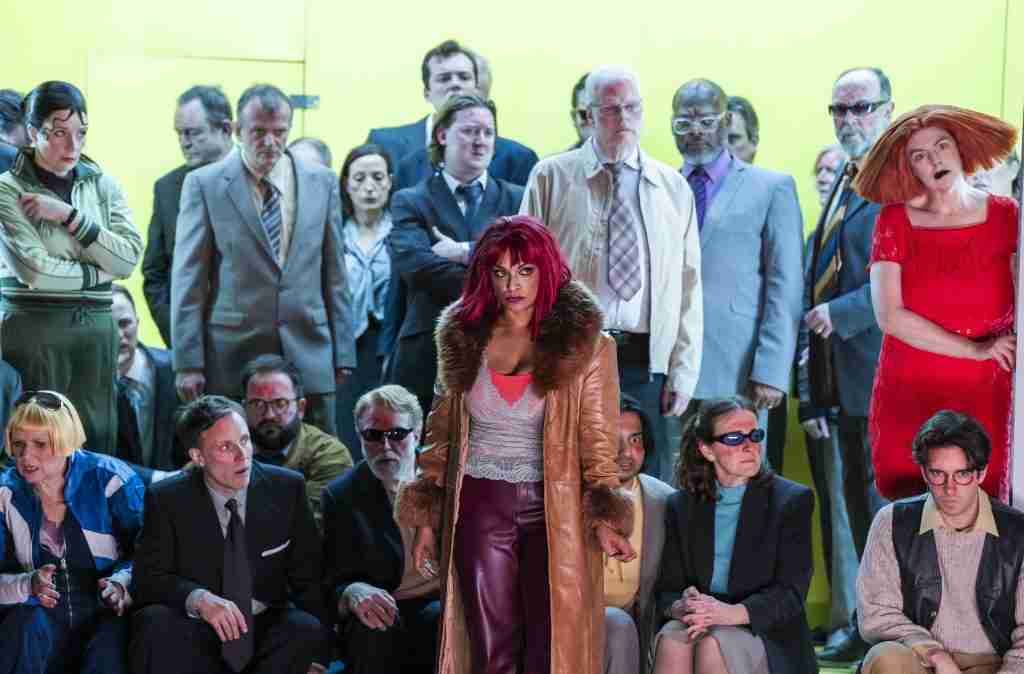
century friar Domenico Cavalca. Among such an eclectic mix of literary and musical sources, the set (featuring two tiers of Tuscan arches in a gaudy, almost art nouveau vision of the Renaissance) and a chorus clad in 18
th
century undergarments add to the mishmash and don’t enrich the work’s Christian theme or repurpose it for our era. That chorus only appear as though from the 18
th
century (even more improbably for a Christian story, the age of Enlightenment) because they recur in the same form in
La bella dormente
, fitting in exactly with the essentially colourful Rococo character of this presentation, and that vividness is in better keeping with this courtly tale, first popularised in Europe in the 17
th
century.
In consequence,
Maria egiziaca
rather feels like it is tacked on to the beginning of this double bill instead of drawing deeper connections with the fairy tale that follows. The one link made is that, just as the chorus of angels at the conclusion of St Mary’s story are reading books – evidently the written narrative of her life – so the sleeping beauty of the following opera comes to life again also reading, and continues to do so to the end, to extend this little extra-theatrical conceit to both works. That is enhanced in the case of
Maria egiziaca
, at least, in that the extracts from the
Vitae Patrum
noted in Respighi’s score are projected on to the curtain during the two musical interludes between its three episodes, rather like the captions in a silent film – and sometimes the drama of the music is like a cinematic soundtrack.
Vladyslava Ionascu-Yakovenko’s Maria is bold and vibrant in her singing, both before and after her conversion to a life of Christian virtue, representing the saint’s charisma. She contrasts well with both Steven van der Linden’s calmly focussed and deliberately passionless sailor, bewailing the sadness and pointlessness of his existence at the beginning of the work, and Alaric Green’s more rugged, initially judgmental Pilgrim and later as the Abbot Zosimus (a Palestinian saint) with whom Mary comes into contact.
Biqing Zhang’s sprightly
coloratura
as the Nightingale and Rachel Roper’s woodier Cuckoo kick off
La bella dormente
. Yolisa Ngwexana is more secure in the equally florid role of the Blue Fairy than in her earlier, weaker account of the Voice of an Angel in
Maria egiziaca
. Ana-Carmen Balestra is measured and charming as the eponymous sleeping beauty, whose finger is maliciously pricked by the spiked glove of the embodied spindle (played by Vladyslava Ionascu-Yakovenko) rather than accidentally sustaining that wound from an inanimate object, perhaps to emphasise the romantic, even erotic nature of her prolonged sleep, brought about by active human agency, just as it will also be ended by the same means, all symbolic of her transition to the emotional and psychological maturity into which she is supposed to awake (though in line with modern sensibilities there is no physical, technically non-consensual, kiss or embrace to rouse her from slumber).
Where Joe Chalmers is commanding as her father, the King, Jonah Halton uses too much head voice as Prince April who awakens her ‘several hundred’ years later, such that he sounds too strained and lacking heft for the rapturous passage in duet with her that forms the work’s musical climax. Steven van der Linden is splendidly vulgar as Mister Dollar, the alternative suitor for the Princess, and Holly Brown aptly snarls in the largely spoken role of the Green Fairy, who does battle with the Blue Fairy for the fate of the sleeping one.
Dominic Wheeler leads a mellow, solemn account of
Maria egiziaca
, particularly in its more liturgically inspired passages, with plainsong-like melodies harmonised in block chords like a mediaeval
fauxbourdon
(and another link to some of Debussy’s scoring for
Le Martyre de saint Sébastien
) but elsewhere pointed up with more drama and passion. The performance of
La bella dormente
draws out an attractive array of instrumental colours – more so than I recall was the case with RCM’s performance back in March, and providing an appropriate counterpoint to the visual vibrancy of the production. The Guildhall chorus ring the changes between the more ethereal sequences of the first opera, and their more sensual approach as the creatures of the woods for the second, often sounding more like the Flower Maidens of
Parsifal
. The RCM’s production of
La bella dormente
dug deeper into the drama, but the Guildhall now have the edge for the sparkling musical performance, though the staging is more than perfunctory and reveals a work that perhaps should feature more often than it usually does on stage (notwithstanding the coincidence of two productions in London this year), especially as a fairy tale for Christmas time.
Further performances to 13 November with alternate casts
←
音乐会评论
《睡美人》——三幕歌剧,由吉安·比斯托尔菲根据夏尔·佩罗的童话故事《睡美人》改编的剧本[意大利语演唱,配有英文字幕]
As the programme notes for Victoria Newlyn’s production of this double bill of Respighi stage works points out, neither of these works were originally created as conventional operas. His version of the sleeping beauty story