Comparisons between
Cavalleria rusticana
(1890) and Rachmaninov’s first opera
Aleko
(1893) have often been made, in terms of their themes of adulterous passion and jealousy, violence and murder, among communities that were marginal and remote from the bourgeois audiences who first saw these works. Indeed it was the perceived sense of freedom and distance from the conventions of their contemporary existence that made attractive for such opera goers in urban centres the microcosms of rural Sicily, and gypsies on the edge of the imperial Russian empire as settings for those respective operas.
Karolina Sofulak’s productions for Opera North (a revival of
Cav
from 2017, but a new
Aleko
) update them so that they become not escapist fantasies, glamourising essentially exotic and inaccessible worlds, but an examination of the elusive nature of freedom in contexts closer in time and place to our own, reclaiming the original purpose of the
verismo
. That works all the more arrestingly in such a warhorse as Mascagni’s well-known one Act opera, to whose emotional impact regular opera goers have probably become somewhat immune. But it also provides a stimulating background to the dramatically flawed
Aleko
(the libretto being weak rather than Rachmaninov’s music) by tying in some of its characters with the story of Mascagni’s opera through the subtle metatheatrical device of using the same singers across the two works.
The religiosity which roots
Cavalleria rusticana
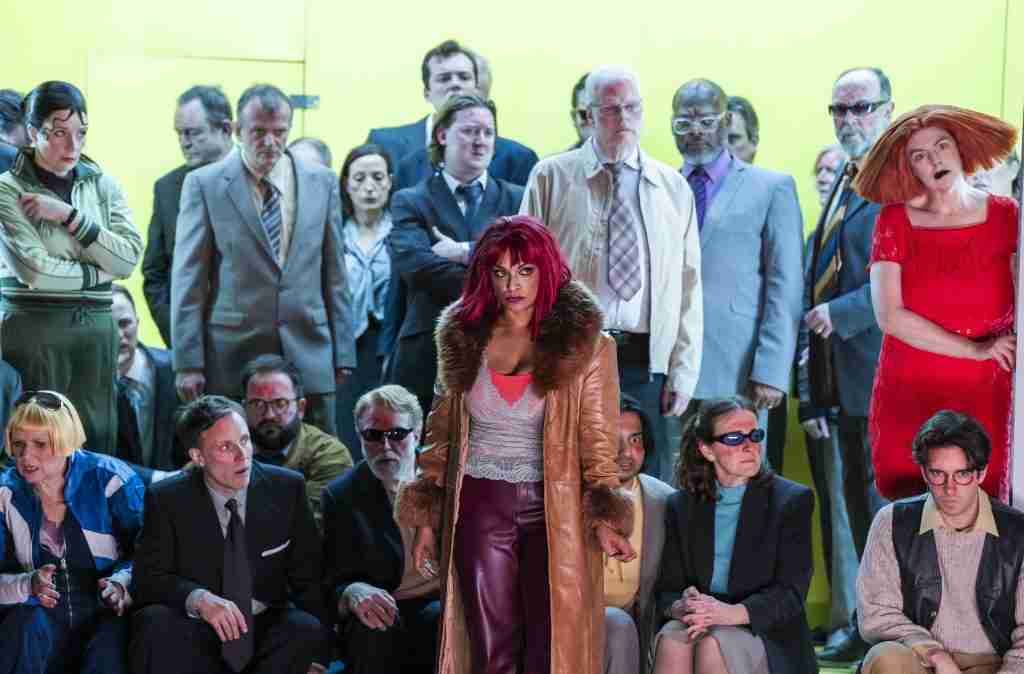
is, in a sense, intensified by moving the drama forwards to 1970s Poland, demonstrated by Santuzza’s devotions before a sizeable cross in relief, and by a sentimental, hagiographical portrait of Karol Wojtyła (Archbishop of Kraków, later Pope John Paul II) on the wall. Catholicism here underlines the hypocrisies and desperations of a society materially and spiritually circumscribed by Communist rule, where Lucia’s wine shop becomes an austere grocery store offering meagre rations to the local citizens, to whom under-the-counter wine is provided to favourites if they are willing to pay her. Ironic connections are made with the practices and traditions of the Christian Church as when Turiddù assumes the role of the crucified Christ during the drama’s action at Easter (in his case as much the victim of his lustful passions as of Alfio’s revenge) and to whom his mother and Santuzza appear in the role of the Virgin Mary and Mary Magdalene respectively. Also, as the joyful villagers assemble in the shop, praising wine, Santuzza appears as the only source of holiness and redemption when she manages to divide the bread evenly among everyone so that nobody goes away empty handed (like a sanitised version of Jesus’s miraculous feeding of the five thousand) and the secret stores of wine are freely given out to everybody, in a secular enactment of the Eucharist, from which they have all just come, out of church. It’s a potent mixture of emotions and ideas, made the more searing by being played out entirely within the close confines of Lucia’s shop, and the fatal shooting occurring in Alfio’s taxi.
The vocal performances emphasise the production’s tensions, above all in Andrés Presno’s smouldering, effusive account of Turiddù, alongside Giselle Allen’s steely interpretation of Santuzza, not always conventionally lyrical, but cultivating a fair degree of volatility so that her curse of Turiddù doesn’t come from nowhere. Robert Hayward is somewhat wooden on stage rather than furious as the betrayed Alfio, but he projects a more convincingly fearsome character in his sternly unyielding singing. Anne-Marie Owens’s throatily expressive enunciation as Lucia makes her sound haughty and disapproving, rather than a doting mother, and so adding to the forces ranged against Turiddù. Helen Évora is effective the small part of Lola, the woman whom Turiddù had loved before she married Alfio, but to whom he has since returned with disastrous consequences.
Aleko
bears a similar story of a
crime passionel
, prompted by the eponymous character hearing his father-in-law, an old gipsy, recount how his wife left him for another man but did not exact any revenge. Aleko is perplexed by that and when history repeats itself with his own wife, Zemfira’s betrayal of him, he murders both her and her lover. Although Sofulak doesn’t carry over the same concept from
Cavalleria rusticana
for this opera as such, connections are drawn by having Hayward take the role of the wronged man again, and Presno as the Lover who seduces his partner away from him, as though Hayward’s Aleko is Alfio sometime later and experiencing the same personal crisis again. Owens also reappears in the brief part of the Woman, in the same guise as Lucia, after Aleko has committed double murder. Sofulak casts them and their peers not as gypsies, but as something like hippies in a commune, with a colourful, almost psychedelic, backdrop of sun-drenched dunes and palm trees, evoking their apparently unbound, carefree existence.
The production makes up for the lack of dramatic opportunities in the libretto by filling in its gaps (taken up by a couple of lively musical interludes by Rachmaninov) with some vivid choreography, ably executed by the Opera North Chorus, which briefly foretells Aleko’s jealousy and rage. The score, premiered just after Rachmaninov had turned 20, may not yet feature the composer’s distinct musical style; but its vocal setting is efficient, and orchestration notably confident, just occasionally hinting at later works such as the
Symphonic Dances
and
The Isle of the Dead
in some knottily chromatic passages. However, Tchaikovsky hovers prominently over the music, those purely instrumental sequences as much like anything from the ballets as from the operas; and there is a brief sequence of oscillating, ominous chords which sound almost exactly like those at the opening of the symphonic poem
Francesca da Rimini
, a subject which Rachmaninov would later take up himself for another opera.
Hayward’s Aleko is more successfully urgent than his Alfio, coming into his own as a more theatrically immediate character, riven by torment and grief. Elin Pritchard makes for a wonderfully coaxing Zemfira, and Presno is cheerily passionate as the Lover, both tipping Aleko over the edge. Matthew Stiff gives a genial, stoical rendition of the part of Zemfira’s father, the old man who’s own backstory sets the theme for the opera. The Chorus give both this work and
Cavalleria rusticana
real bite, doing as much as any of the solo characters to create a sense of inevitable tragedy. Antony Hermus conducts the Opera North Orchestra in engagingly lucid interpretations, often blossoming in a poignant Romantic delicacy – not least in the famous Intermezzo – but deepened by richer, almost Wagnerian sonorities to lend gravitas.
Aleko
may still come across as a merely worthy effort by the student Rachmaninov, rather than a masterpiece, and really an anti-climax after
Cavalleria rusticana
where it would probably have been better to come before. But undoubtedly this is a committed and worthwhile attempt to bring a little-known stage work to light, and Mascagni’s ubiquitous opera surely benefits by being paired with something other than
Pagliacci
.
Further performances at various locations to March 22
←
音乐会评论
Opera North – Mascagni’s Cavalleria rusticana and Rachmaninov’s Aleko with Giselle Allen, Andrés Presno, Robert Hayward & Elin Pritchard; directed by Karolina Sofulak; conducted by Antony Hermus
Comparisons between