Thomas Mann’s literary art is noted for the various potent dichotomies which it frequently poses for consideration – between youth and maturity, growth and decay, thought and action, form and idea; and most importantly, subsuming all of those, the notion he took from Nietzsche – the dialectic between the Apollonian and Dionysian approaches to life. It is under the guise of the latter philosophical concept that his celebrated novella
Death in Venice
dealt with the much more difficult topic (at least in 1911 – and not a great deal easier for Britten in his opera of 1973) of erotic desire, especially same-sex attraction, even if unconsummated.
Olivia Fuchs’s new production for Welsh National Opera generally successfully takes up the challenge of rendering those themes more explicitly, but maintaining poetic sensitivity and lyricism on stage as Aschenbach’s homoerotic desires are played out by a circus troupe. They comprise Tadzio (Antony César) and his friend Jaschiu (Riccardo Saggese), as well as three females (Diana Salles, Vilhelmiina Sinervo, and Selma Hellmann) so that there is initially a hetero- as well as homosexual dimension – the divisions and regroupings of the dancers perhaps invoking Aristophanes’s fantastical notion in Plato’s
Symposium
(a dialogue about the power of love) that humans were originally created as conjoined pairs (of both the same and different sexes) before Zeus split them up such that each individual person engages in a search for their other half. But the choreography – both energetic and graceful – increasingly focuses on the two young men, with the lithe bodies of Classical Greek statuary, engaging in ever more physical rapprochement before Aschenbach’s entranced eyes. (There is, briefly, a more camply comic – or even Freudian – undercurrent when the well-built Saggese also takes on the part of Tadzio’s Governess, in correct female dress.)
To that extent the artistic autonomy of their movement and dance compellingly channels the Dionysian element of freedom, frenzy, even chaos in a way that only live theatre can achieve by actually embodying that in performance, which Mann’s novella can only describe as an idea, and which Luchino Visconti’s magnificent film (1971) only indirectly evokes so as not to unsettle what is otherwise a realist re-telling of Aschenbach’s story. However, the long stretches of spectacle do break up the continuity of the drama with which, I for one have to confess, it is difficult to remain engaged owing to the scarcity of Britten’s music – for me, really a series of inconsequential gestures in sound rather than a score of fully sustained, rigorous musical argument (a few very brief, recurring quasi-themes or instrumental timbres aside). In what is already a sparse musical drama with its diversions on cod-philosophical aesthetics in Myfanwy Piper’s libretto rather than more dynamic action, I wonder whether the choreography tips the balance too far in the direction of something abstract and conceptually static, rather than developing Mann’s ideas insofar as they are theatrically adumbrated in the opera.
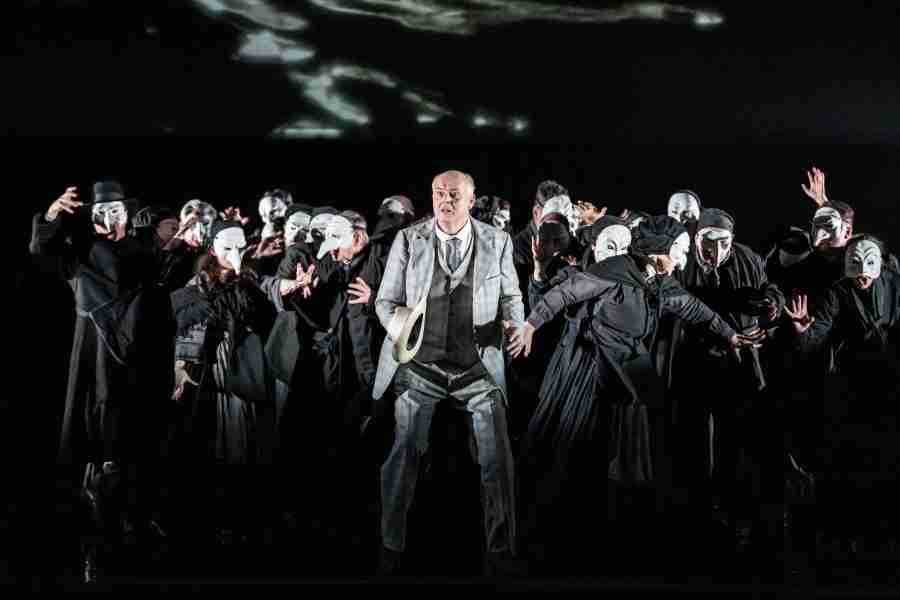
If anything binds the whole together, it is the manner in which Fuchs directs our grasp of the unfolding action of Britten’s two-dozen scenes entirely through Aschenbach’s perception. That is tautly achieved by having Mark Le Brocq in the role on stage for virtually the entire time, often along the front, or to the side in a chair observing events when he isn’t addressing the audience directly with his thoughts. In one sense he is, in fact, decentred from the action straight after the first scene – in which he contemplates his career, and then a trip to Venice, from his desk in the middle of his study, never to resume exactly the direct and central focus of our attention until his death at the end. But he remains the framing device through which the rest of the drama is perceived by us. Attention is compelled by Le Brocq’s effortless, fluid delivery of the vocal part, given the naturalness and nuance of speech in what consistently remains a recitative or, at most, an arioso-like setting by Britten, firmly dictated by the latent music and rhythm of the libretto’s words in the words (it’s interesting that Britten kept Aschenbach as a writer, rather than turning him into the Mahler-like composer of Visconti’s film). Like the novels of Henry James (another artistic figure influenced by Venice) where the person of any narrator becomes essentially dissolved in the re-telling of the story itself, so here Le Brocq’s embodiment of Mann’s writer in the opera makes him an effectively passive conduit for the haunting sights and experiences of the Venetian lagoon.
Fuchs tellingly preserves another Mannian juxtaposition, that between reality and idea. Rather than having any very literal, realistic depiction of Venice, it is conjured as an almost dreamy, nostalgic or even spectral concept in Sam Sharples’s black and white video projections of unpeopled images. They form a constant backdrop to the performance, and sometimes comprise a sequence of generically lapping water alone. But that is enough of a reminder of Venice’s own dialectical contrast, as a ‘marriage between stone and water’ (as the opera’s libretto puts it). It is the water which has the last visual word (to mix metaphors) as that is the image which remains at the end – under or into which Tadzio recedes and before which Aschenbach dies. A reminder that, perhaps, water is the last and most enduring component of Venice, after stone and heat, as well as plague and decay in the case of Mann’s tale – the element that yet another writer, Joseph Brodsky, mused upon as its most essential in his essay on the place,
Watermark
.
Musically the idiosyncrasies of Venice are evoked in Roderick Williams’s wonderfully adept transposition between no fewer than seven different characters, from the insidious, wily tone of his mysterious Traveller who first lures Aschenbach to Venice, through an ingratiating Gondolier, a crudely vigorous Leader of the Players (some in character of the
commedia dell’arte
tradition, the one concession to a realistic recreation of Venetian customs), and an impassioned Voice of Dionysus. He is aptly contrasted by the tense, slightly sliding tone of Timothy Morgan’s countertenor as the Voice of Apollo, whether by accident or design sounding distinctly like James Bowman (who created the role in 1973). The performance is rounded out by creditable contributions from a sizeable cast with very brief appearances, though mention should be made of Peter Van Hulle’s furtive Hotel Porter and Gareth Brynmor John’s amenable English Clerk. Leo Hussain leads the WNO Chorus and Orchestra in a fidgety, dry account of the score, which tends to emphasise its very lack of continuity. Oxford’s New Theatre probably aggravated that, but in the opening of the opera, at least, the effect usefully suggests the desiccation of Aschenbach’s artistic inspiration.
This is an unquestionably slick execution of Britten’s final opera. But the question remains whether staged productions of Mann’s largely intellectual (rather than linear) novel in this operatic adaptation can escape the visual atmosphere of Visconti’s superb film (both David McVicar’s and Deborah Warner’s productions for the Royal Opera House and English National Opera respectively stay within its ambit). The circus acts mark an imaginative step forwards, away from its realism. But insofar as there is, otherwise, a setting here in Fuchs’s vision, it is still fundamentally rooted in the world prior to the First World War (essentially coeval with the British Edwardian age). Paradoxically, the somewhat precious trains of thought and expressions in Piper’s libretto leave the opera more problematically tethered in a twee, E. M. Forster-world of personal and psychological development than Visconti’s film, which daringly uses so little spoken dialogue but more subtly allows visual montage to tell just about everything in a timeless manner. Those who already admire the opera will be stimulated afresh by this production; others may be newly won by it to Britten’s cause. But the production still doesn’t quite convince me that the work is a masterpiece – it seems that the beauty of ideal, Apollonian artistic form remains too grounded in historical literalism.
Further performances at various locations to May 11
←
音乐会评论
Welsh National Opera – Britten’s Death in Venice – with Mark Le Brocq, Roderick Williams & Timothy Morgan; directed by Olivia Fuchs; conducted by Leo Hussain
Thomas Mann’s literary art is noted for the various potent dichotomies which it frequently poses for consideration – between youth and maturity, growth and decay, thought and action, form and idea; and most importantly, subsuming all of those, the notion he took from Nietzsche – the dialectic between the Apollonian and Dionysian approaches to life. It is under the guise of the latter philosophical concept that his celebrated novella