A ‘bourgeois comedy’ is how Strauss described his autobiographical opera (1924), based on a real incident in which a misdirected letter (owing to the confusion of Strauss’s name with a similar one) was wrongly interpreted by his wife, the soprano Pauline de Ahna, as evidence of a love affair and therefore grounds for a divorce. And it was the tender affections of the bourgeois mindset that has tended to keep this opera from attaining wider admiration and more frequent stagings as being a vulgar subject for the theatre. (Hoffmansthal and other potential librettists disdained to produce a text for Strauss, with the result that he wrote a rather witty, dynamic libretto himself, drawing upon his altercations with the fiery Pauline.)
To a certain extent Tobias Kratzer’s new production for the Deutsche Oper makes a virtue of its perceived vulgarities and brings them centre stage: in general, the sparse set particularly focuses attention on the tensions between Strauss’s alter ego, the
Hofkapellmeister
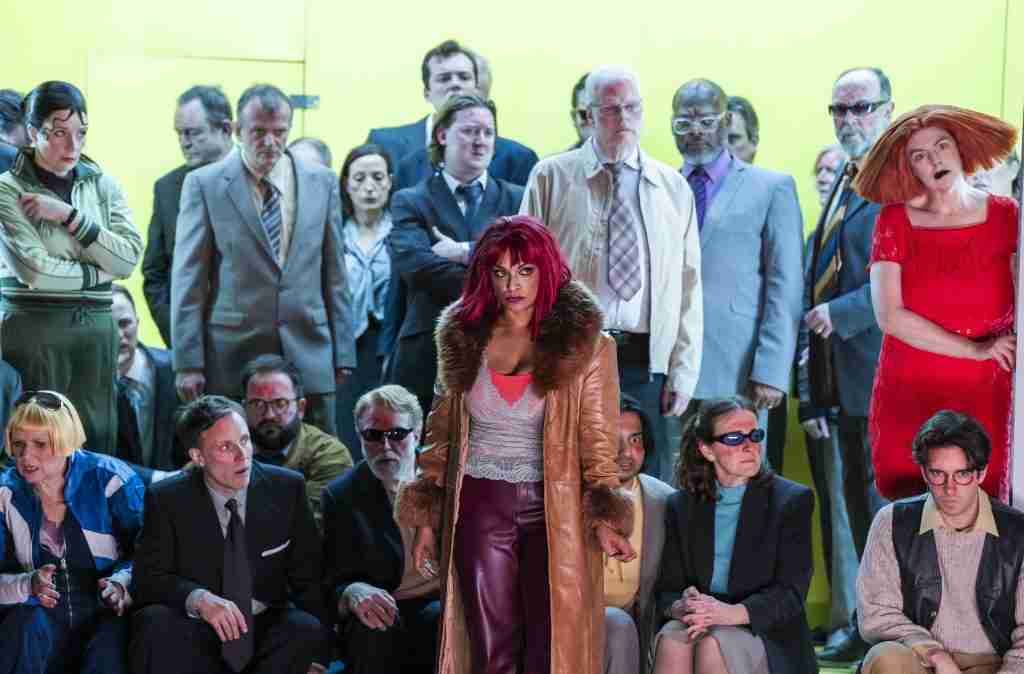
Robert Stroh and his wife, Christine, and her flirtation in turn with the younger Baron Lummer, making it a highly-strung domestic play or even perhaps a sort of bourgeois kitchen sink drama. Specifically the squabbling between husband and wife in the very first scene takes place in front of a taxi driver outside of their house, as the vehicle is loaded with Robert’s luggage in readiness for a concert tour, which his wife doesn’t accompany; and in his absence, her flirtation with Lummer at a ball, is no chaste encounter, but consummated as they are seen in bed together.
Despite the contemporary setting, the reference of the latter scene appears to be to the Marschallin’s adultery with Octavian in
Der Rosenkavalier
. Kratzer doesn’t simply concoct such scenes for mindless, prurient fun, however, but makes a more serious, even tragic point in the midst of this comedy, about the subservient position which the wife of a bourgeois family was (still is) expected to assume at home (de Ahna largely gave up her singing career after her marriage to Strauss). Here she is shown as subsidiary to the musical activities which Stroh pursues in his professional life, and which their young son, Franzl, is also being trained to follow. In the scene where the relatively impoverished Lummer comes to Christine, seeking patronage and financial support for his music studies while Stroh is away, they play around with costumes, adopting the roles of characters from Strauss’s operas in amorous situations which correspond ironically to their situation – Apollo and Daphne, Octavian and Sophie (an even richer irony in that Christine has already adopted the role of the Marschallin in relation to Lummer), Flamand and Countess Madeleine (
Capriccio
), and most sardonically, Jochanaan and Salome – in other words, those female roles being ones to which Pauline served as muse, but which she never performed herself. When Christine approaches the Notary for a divorce, it is in the frenzied demeanour of Elektra, threateningly brandishing an axe with vengeful force. The point is finally made in the final scene of supposed reconciliation, in which Christine doesn’t sing the good wifely words of remorse and obedience freely, but is made to do so by Stroh by giving her the score of the opera to sing them from, as he then leaves her (again) to take up the direction of an orchestra at the back of the stage. We don’t condemn her, then, for her adultery, but perhaps even sympathise with her need for emotional release (just there is no judgement or critique of the Marschallin in
Der Rosenkavalier
). And in a sense too, Kratzer brings the ambit of this apparently comic opera by Strauss – that great admirer of Mozart – within that of C
osì fan tutte,
as an uncomfortable, unsettling examination of the complex, difficult dynamics of personal, emotional relationships which ends with a question mark rather than a resolution.
With more light-hearted humour, contrasting with the focus on Christine within the drama, the role of the
Hofkapellmeister
is brought to the fore during the ‘symphonic interludes’ (effectively Strauss’s true voice in the opera as the brilliant orchestrator he was) between the staged scenes, as video projections show the orchestra in the pit playing them – the thing which Robert lives for and which Christine experiences, at best, only vicariously. There is a comic aptness in the fact that the conductor here, Sir Donald Runnicles, is not dissimilar from Strauss in appearance, although it is Storch’s conductor colleague, Stroh, who is made to resemble Runnicles (with Stetson and cowboy outfit too).
The performers don’t merely do justice to Strauss’s underrated, imaginative score, but engage sensitively with Krazter’s interpretation. Maria Bengtsson gives a commanding account of the impulsive Christine, by no means strident or hectoring, but with formidable control and purpose which articulates her predicament of frustrated agency. Philipp Jekal is an often stern-sounding Robert, making him here the somewhat neglectful, career-driven husband rather than the patient, forbearing one of (Strauss’s own) libretto. Thomas Blondelle affects a certain wilful naivete and charm as Lummer, as he seeks to ingratiate his way into Christine’s favour. Vivid, more expressly burlesque performances are given by Anna Schoek, as the maid Anna, and Markus Brück and Nadine Secunde as the Notary and his wife. Clemens Bieber is a characterful Stroh.
Runnicles oversees a lucid, often conversational account of the music with the Deutsche Oper Orchestra. In a score which Strauss punctuated with meticulous comments about dynamics and expression, Runnicles generally reins in the orchestral textures for the sung scenes to allow the repartee to come across clearly (except in the first scene where Christine is a little overwhelmed) but the orchestra attains fuller force for the broader sweep of the interludes. But an array of instrumental detail is carefully, subtly etched – the brief quotation from
Ein Heldenleben
when Christine mentions Robert’s uncharitable critics being an obvious example.
The production’s sparse sets never seem lacking as they ensure that the drama isn’t sugared with crass or distracting humour, but it remains securely fixed on the scenario’s tragicomedy, avoiding sentimentality or banality. Just as Strauss essentially cast himself in the opera, so this staging now projects the work back into Strauss’s life, even if somewhat obliquely. Its lightly-worn wit is clever, but also poignant, as well as demonstrating that this neglected opera is a work of more depth and imagination than it has often been given credit for.
Further performances to June 14
←
音乐会评论
Deutsche Oper, Berlin – Richard Strauss’s Intermezzo – Philipp Jekal, Maria Bengtsson & Thomas Blondelle; directed by Tobias Kratzer; conducted by Donald Runnicles
A ‘bourgeois comedy’ is how Strauss described his autobiographical opera (1924), based on a real incident in which a misdirected letter (owing to the confusion of Strauss’s name with a similar one) was wrongly interpreted by his wife, the soprano Pauline de Ahna, as evidence of a love affair and therefore grounds for a divorce. And it was the tender affections of the bourgeois mindset that has tended to keep this opera from attaining wider admiration and more frequent stagings as being a vulgar subject for the theatre. (Hoffmansthal and other potential librettists disdained to produce a text for Strauss, with the result that he wrote a rather witty, dynamic libretto himself, drawing upon his altercations with the fiery Pauline.)