André Campra was an important figure in the development of French opera between the death of Lully (1687) and Rameau’s first example,
Hippolyte et Aricie
(1733) not least by pioneering the form of the
opéra-ballet
in
L’Europe galante
. Such works integrated more extensive sequences of dancing within their structure, and the plots tended to be more comic and rely less on classical mythology. Campra’s next piece
Le carnaval de Venise
(1699) exemplifies that form well. Its framing device sends up the serious pretensions of the typical Lullian
tragédie en musique
in that preparations are underway for a performance of ‘Orpheus in the underworld’. The goddess Minerva intervenes – as the Classical deities were wont to do in the prologues of the older operas, allegorically representing the monarchy – commanding a more amusing entertainment and chooses the carnival at Venice as its subject.
The ensuing story features the usual twisted chain of amorous interests – in this case not so much a love triangle as a love quartet. Léonore is besotted with
Léandre
but discovers from Isabelle that he loves her instead. Meanwhile Rodolphe suffers the pangs of jealousy with respect to Isabelle, only to learn from Léonore that Isabelle prefers Léandre instead. Rodolphe and Léonore are, consequently, set on revenge. Things don’t come full circle, however, as Léonore rejects Rodolphe when he makes an advance. Events also take a grimly comical turn when, against the backdrop of the annual Venetian festivity of the ‘fight on the bridge’, it is reported that Rodolphe’s attempt to kill Léandre goes awry and he has accidentally murdered another man. The drama seems curiously inconclusive, however, as once Isabelle and Léandre are securely paired up and seek their means of escape from Venice, nothing further happens – we find out nothing more about Rodolphe or Léonore, nor about the unfortunate anonymous victim. Instead, the spectacle returns to
Orpheus
, given as a play within the play. It’s also paradoxical that these framing sections become the more comical ones, and the central narrative more serious.
It’s another curiosity that the work is something of a stylistic, as well as a structural, hybrid in that the central portion of the drama is in French, but is bookended by the Prologue and production of
Orpheus
in the Italian style and language (though the Prologue is given here in English translation) with their more floridly melodious writing, somewhat in the manner of Cavalli, a generation earlier. In Campra’s time there was a debate in France about the validity and desirability of foreign – especially Italian – forms of music and drama, and the extent to which these could be synthesised with the French style, not least with the latter’s extensive use of dance forms. If there’s any consensus about that debate today, it is probably that, however delightful the music for the dances, modern audiences tend to find them tedious in the context of opera as they hold up the action – even in all those other French operas from Lully onwards where dances are more intermittent, never mind where the choreography is a more extensive part of the spectacle, constituting whole scenes in themselves.
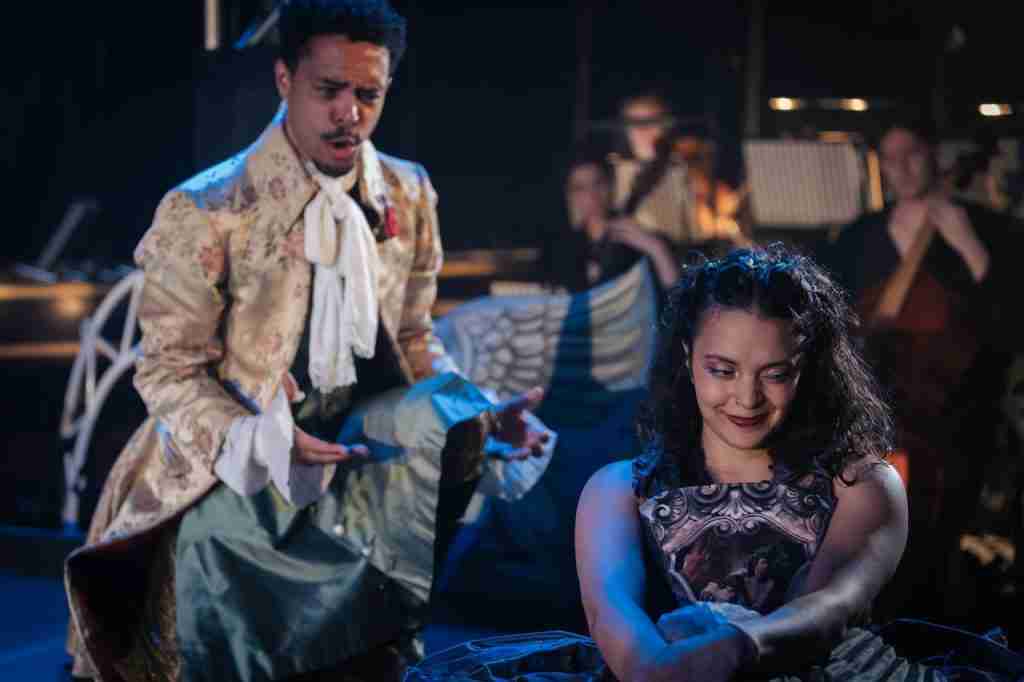
James Hurley’s solution in this production is to give over the choreographed sections to the novelty of circus display rather than classical dance, Hannah Finn & Shane Hampden providing some athletic spectacle alongside the appearance of the drama’s characters as though from the
commedia dell’arte
. The authenticity of such a connection may be recalled from the famous fresco of acrobats by Giandomenico Tiepolo, in the Pulcinella Room, now installed at the Ca’ Rezzonico in Venice. Furthermore, some of the circus routines take their inspiration from the stage action itself. Fortune is borne aloft on a crescent moon at one point, as there is a reference to the elevation of love “up in the air”. While a song is performed about beauty being found in the face, Hampden performs tricks with a spinning circular frame, suspended across it like da Vinci’s Vitruvian Man, exemplifying the ideal beauty of the human body. Choreography and the opera’s subject are therefore successfully and imaginatively integrated for the colourful display of Venetian festivities.
The performers offer as much vitality in the music. Katie Bray blossoms as an initially reserved Léonore but then unleashing a greater display of vocal fireworks in her fraught dealings with Léandre. Themba Mvula brings a lyrical ardour in that part, if slightly catarrhal, resulting in diction that is not quite distinct between the different French vowel formations. As his beloved Isabelle, Julieth Lozano sings with some delicacy and sweetness, a less volatile lover than Léonore. If the character of Rodolphe erupts into violence, Tristan Hambleton gives an account that is weighty but controlled. In the
Orpheus
section – hammed up to become almost a pantomime comedy – Giuseppe Pellingra cultivates an amusing mock gravity as the king of the underworld and Feargal Mostyn-Williams an otherworldly, wavering
falsetto
as the mournful Orpheus, adding to the sense of satire in this presentation.
Jonathan Darbourne and the Vache Baroque Band navigate well the shifts between the musical styles and dramatic registers in the opera’s different parts, supple in rhythm, ornamentation, and timbre for the French, bolder in colour and more sustained melody for the Italian. In ensemble the solo singers combine heartily for the choral sections. Given more or less in the round – the audience on three sides of the stage at least – this production brings an exhilarating immediacy to a rarely performed work, asserted here to be its UK premiere.
←
音乐会评论
关于此网页
André Campra was an important figure in the development of French opera between the death of Lully (1687) and Rameau’s first example,