Bianca e Falliero
(1819) is one of the operas Rossini composed during his period in Naples, but is set in Venice, and was actually premiered at La Scala (Milan). Its narrative is a standard formula of conflicted personal and public loyalties, as the lovers of the title are opposed by Bianca’s father – although Falliero has heroically seen off a Spanish force that threatened the Venetian republic, Contareno (a state senator) wants Bianca to marry another senator, Capellio, to overcome the difference between their families, and because the latter is rich (unlike Falliero).
The fact of the opera’s plot and Rossini’s sticking to the standard slow-moving form of
opera seria
(rather than experimenting with a more fluid or varied structure as he did with his other Neapolitan operas) is fair game for director Jean-Louis Grinda to expose the mechanics of the composer’s dramatic art, as he explains in the programme, seeing that it chimes in less with our greater expectations as to dramatic realism in the present day. Grinda’s idea doesn’t result in anything very radical or probing in terms of Rossini’s operatic style specifically, and is best read as a general pealing back of operatic conventions – especially those of
opera seria
(let’s say from the period of Alessandro Scarlatti to Rossini’s own, last example,
Semiramide
) which are founded upon the rigid sequence of arias (and other solo numbers) and recitatives (the latter, in
Bianca e Falliero
, are still largely scored for pianoforte continuo, rather than orchestral accompaniment). Here, that approach means having the (relatively few) scene changes carried out in full view of the audience, as a graphic way of marking the manner in which those recitatives serve as the (somewhat artificial) shift in gear, or palate cleanser, between strongly contrasting arias on either side of them. For better or worse, the changes here are brief anyway, as the set is not complicated and certainly not a lavish design as was typical of the early 19
th
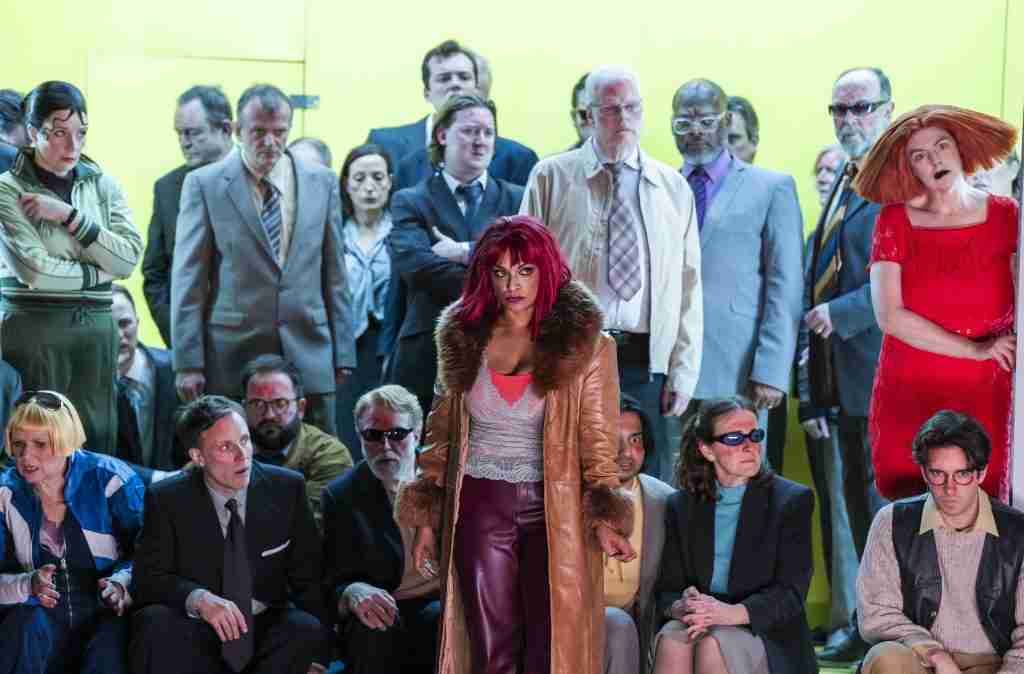
century. Choreography tends to be fairly static (as it was in Rossini’s time, even if the protocol of theatrical gestures from then are not utilised here); and a standard Brechtian ‘alienation’ effect is achieved by having Bianca’s confidant Costanza conduct the chorus of servants as an ensemble of chambermaids on stage.
The setting is brought forwards from the 17
th
century to the 1950s or ’60s, which no longer really makes sense of the Venetian context since it had vanished as an independent state long before that, but nor is any other particular place evoked in the plain marquetry of the set, or the video footage of people in commotion, running through the streets of an unspecified Italian town centre – though it certainly isn’t Venice. That city is only summoned up in the backdrops – a view across to San Giorgio Maggiore for Act One (which at least, therefore, positions the action correctly from this perspective, on St Mark’s Square or the Doge’s Palace) and a general vista of one of the main waterfronts for Act Two.
The one respect in which Grinda does engage with the specific material of this opera is that its librettist, Felice Romani, revised the tragic ending of the play on which it is based and gave it a happy conclusion instead, so that Bianca’s father relents, and Capellio exercises compassion, enabling her union with Falliero. Grinda has his cake and eats it by having Bianca sing the music for the triumphant ending (which re-uses the concluding rondo of
La donna del lago
) but in a self-absorbed delirium or fantasy, while the other characters remain essentially frozen, leading us to believe that Bianca merely entertains a delusion, and there is no reprieve for her after all (or Falliero, who will be condemned by the Council for treachery). That would explain why Bianca is shadowed for much of the time that she is on stage by an elderly blind woman – evidently her future self, disappointed and infirm. It’s a clever idea, even more so as it also seems to engage, almost in reverse, with the Rossini Opera Festival’s previous production of the work which also had it both ways and presented both endings – the bad one as Bianca’s nightmare, before her triumph wins out. But with nearly three hours of music, it’s a long haul before Grinda’s dramatic irony is unravelled.
The singers more than meet the challenge of the music, not least the performances from the two title characters. Both grow into their respective parts during the course of the drama, Jessica Pratt delivering finely chiselled
coloratura
and Aya Wakizono, in the trouser role of Falliero, evincing a tone of cool ardour and keeping her calm even as it becomes apparent that Bianca is to marry Capiello. But more fire comes to each of their interpretations in Act Two, as Pratt avails herself of more hefty vocal volleys and some impressively held top Ds or Es, and Wakizono also achieves a more assertive musical presence and striking high notes of her own for the contralto part.
Dmitry Korchak proves to be a versatile Contareno – frequently vociferous when asserting paternal authority over Bianca, sometimes to the point of aggression and roughness, but he also finds a more lyrically persuasive demeanour too. Although Capellio receives no aria of his own, Giorgi Manoshvili makes a vividly sonorous impression in the role, thoughtful and earnest where Contareno is more impetuous. Carmen Buendía brings charisma in the even smaller role of Costanza.
In quite a long opera Roberto Abbado steers a dependable course through the music. It sets a judicious pace which allows the vocal lines to unfold with due clarity and the Chorus of the Teatro Ventidio Basso to emerge luminously, while also spotlighting some fine instrumental solos from within the RAI National Symphony Orchestra. If the production sometimes lags, the musical interpretation certainly sustains tension and interest of its own.
←
音乐会评论
关于此网页
Bianca e Falliero