Such is the dramatic vitality of Verdi’s
Rigoletto
that there is already a sense that it presents a metatheatre of a corrupt, cruel world, embodied in microcosm in the Duke of Mantua’s court. In her new production for Welsh National Opera, Adele Thomas perceptively emphasises those elements, to underline the title character’s tragedy, by virtuosically weaving several theatrical and visual strands together.
Noting Verdi’s high regard for Shakespeare, and the fact that he was contemplating an opera on
King Lear
around the time he composed
Rigoletto
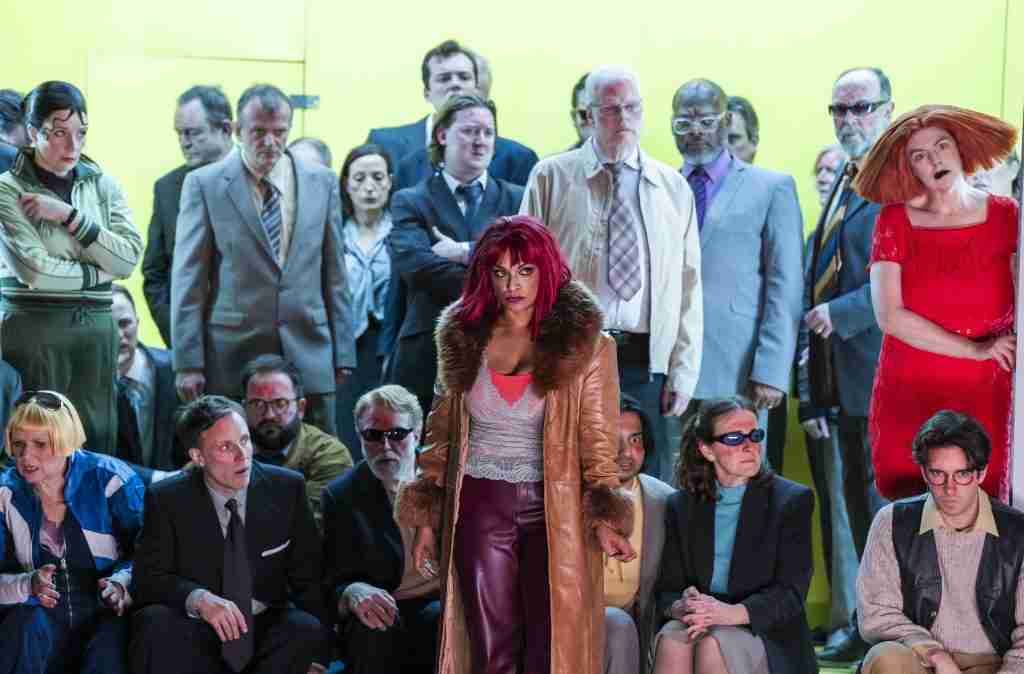
– as well as both scenarios featuring a prominent role for a jester – Thomas draws upon the sartorial style and vengeful, violent themes of Jacobean tragedy for the principal characters. The rest of the debauched court is cast as a sordidly Hogarthian scene from the 18
th
century, in which self-serving, gluttonous abandon prevails. In both cases the courtiers’ deliberately dishevelled appearance, as though sinister pantomime characters, echoes their moral shabbiness, and there is also a hint of the contemporary work by Cold War Steve, lampooning the degradation and decadence of the past 14 years of Tory rule, even if the only specific reference to that period is the head of a roasted pig, recalling the one upon which David Cameron is said to have performed unspeakable acts at a student shindig. All that seems to be missing from the orgy of sordid pleasures to make it really up to date is pink cocaine. Guests eat out of the creature’s entrails, and the wanton depravity depicted in other Jacobean tragedies is mimicked in the violence meted out upon Monterone (here a despised Puritan preacher) and in the slitting of Giovanna’s throat, all presaging the murder which Sparafucile and Maddalena will perpetrate upon Gilda.
The bare tiled set for most of the action presumably evokes the nihilistic, God-abandoned world of which Thomas speaks in her programme note in relation to Jacobean drama, as does the simple, lurid blood-red chamber for the inn where the Duke disports himself in Act Three with Maddalena, set within a dark, empty space beyond. Despite Gilda’s death – which is usually considered to be the means to the Duke’s redemption – here it feels as though he will continue his amoral life, none the wiser for his encounter with such a saint, and probably will find nothing better to do than write his self-justifying memoirs for a healthy financial advance.
Consistent with Thomas’s skill in contrapuntally combining several ideas at once, those settings not only enhance the innate theatricality of the production, but they also relate to her third inspiration, the 18
th
century Venetian painting
Exhibition of a Rhinoceros
by Pietro Longhi, in which the helpless and inert, but noble beast is leered at by absurdly dressed carnival revellers. So it is that Rigoletto is foregrounded in the production and made the focus of the court’s – and our – voyeuristic attention. Stage lights are prominently lined up at both sides as though his tragedy is played out as entertainment for the courtiers, and the lightning for the storm of Act Three comes from within the auditorium around us, as though catching Rigoletto and Gilda in the glare of paparazzi camera lights before our gaze. On two or three occasions, Rigoletto comes upon the action from outside a shabby transparent curtain, on our side of the stage, to encounter the ghostly figure of Sparafucile, drawing Rigoletto on ineluctably to his tragic fate within the court’s arena of cruelty, sealed by Monterone’s curse. Thomas’s fantasy of ideas is rigorously and tautly drawn together; but where, for example, Opera Holland Park’s
Rigoletto
last year was a similar, but entertaining, essay in linking it to political corruption by reinterpreting the scenario specifically as the Bullingdon Club, this is a searing, more general vision of the jester’s suffering as an existential drama.
At the centre of this moral vacuum are arresting, assured performances by Daniel Luis de Vicente and Soraya Mafi in the two lead roles. With music that is usually couched in the form of recitative or arioso, rather than fully-fledged, sustained melody, Rigoletto sometimes seems more like a cipher, caught between the evil of the court and his daughter’s virtue. But de Vicente’s interpretation fleshes out the character with palpable human emotions, from opportunistic goading on of the courtier’s scurrilous behaviour, to warm, impassioned solicitude for Gilda. Mafi’s silvery, agile singing expresses her integrity and purity, but as a fervent young lover rather than a merely ethereal being, and with a nimbleness that matches her performance on stage.
Raffaele Abete’s Duke tends not to be typically romantic in vocal style, his singing coming more from the head than chest, but there’s certainly a florid Italianate colour and garrulousness which captures the Duke’s capricious nature, at least after a muted start. Nathanaël Tavernier and Alyona Abramova offer spectral musical presences as the assassin Sparafucile and Maddalena, his sister and accomplice.
Paul Carey Jones is perhaps more urgent than lugubrious compared with other exponents of Monterone, complementing the simmering, ominous account of the score presided over by Pietro Rizzo, particularly in Act One with hearty contributions from the WNO Chorus. Tension in the WNO Orchestra’s performance eases a little in Act Two, but a quiet determination works itself up for the eerie doom-laden chordal progressions which punctuate Act Three.
With drastic cuts threatening the Orchestra’s livelihood, its players wore sloganed T shirts as part of their ongoing industrial action, and a speech from one of its members urged the audience to sign its petition to protect funding. A gripping
Rigoletto
such as this proves that opera is a huge but worthwhile undertaking whose cultural, intellectual and moral value can’t be measured in vulgar accounting or monetary terms, but which needs the secure, long-term commitment of money and material resources, nonetheless. Otherwise, musical life will surely be reduced to little more than command performances by Taylor Swift at the behest of our new Prime Minister.
←
音乐会评论
关于此网页
Such is the dramatic vitality of Verdi’s