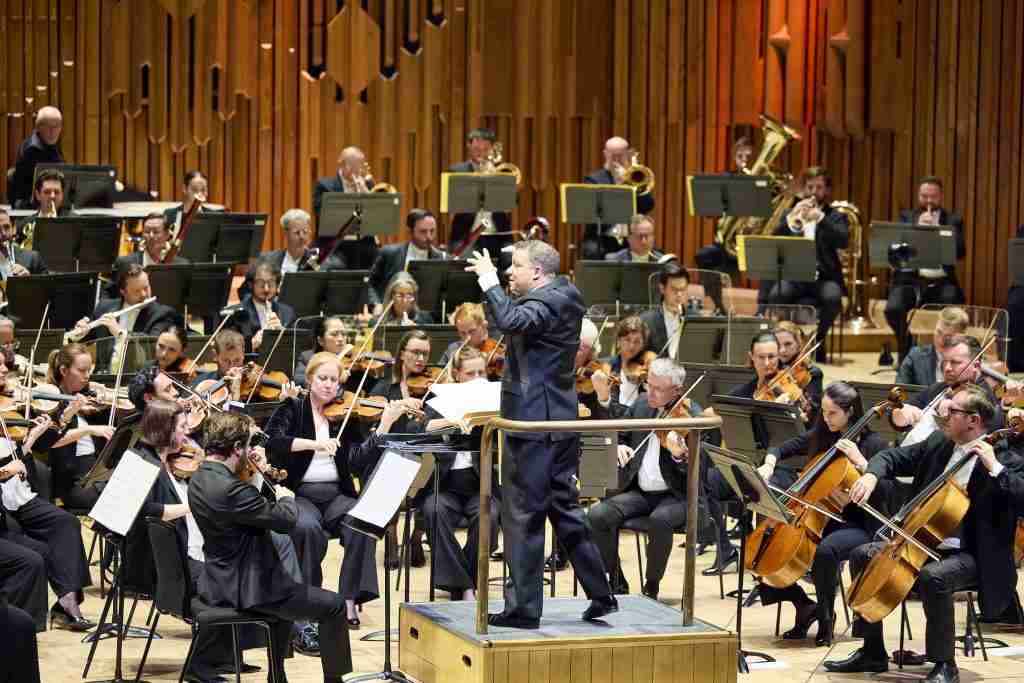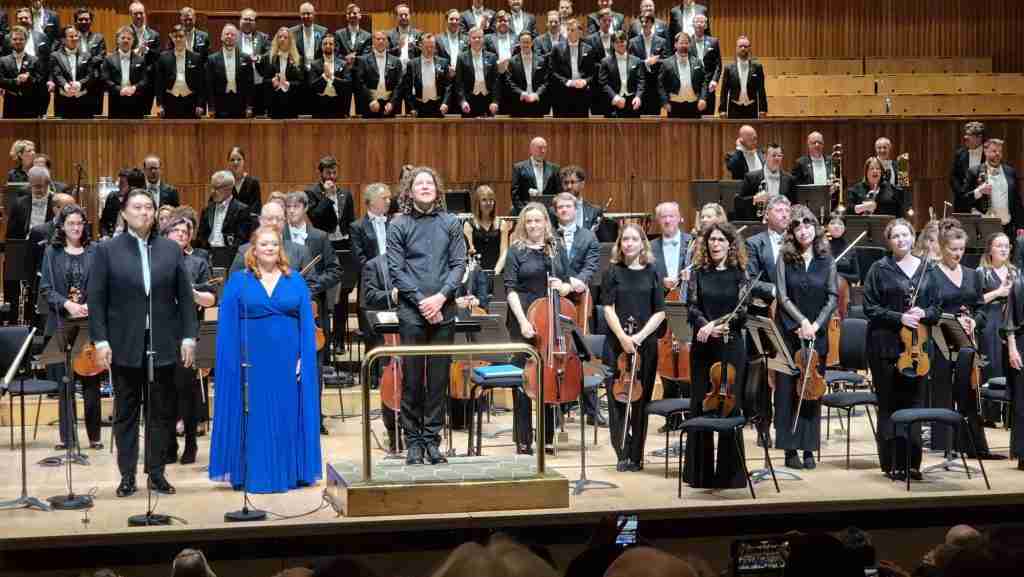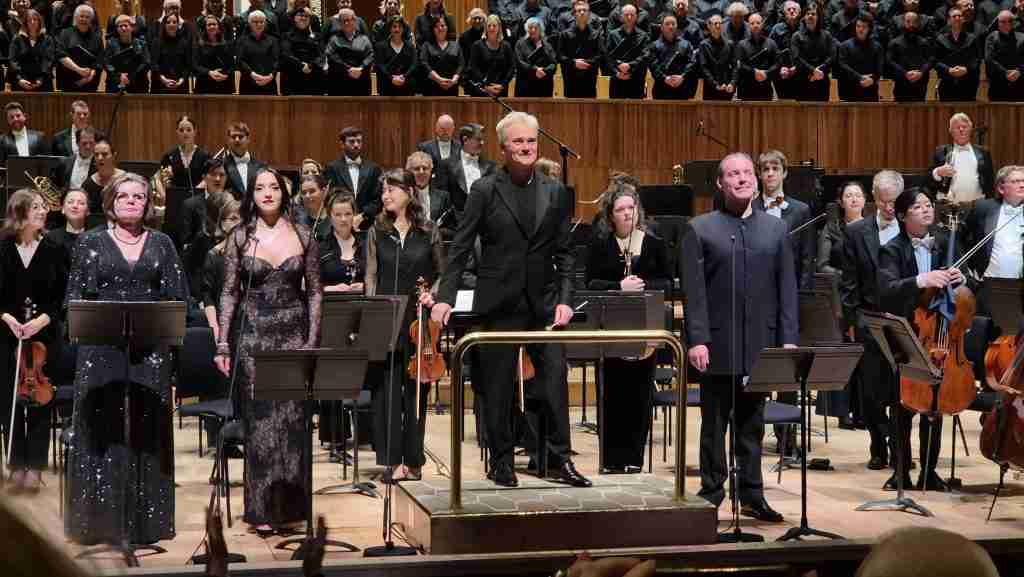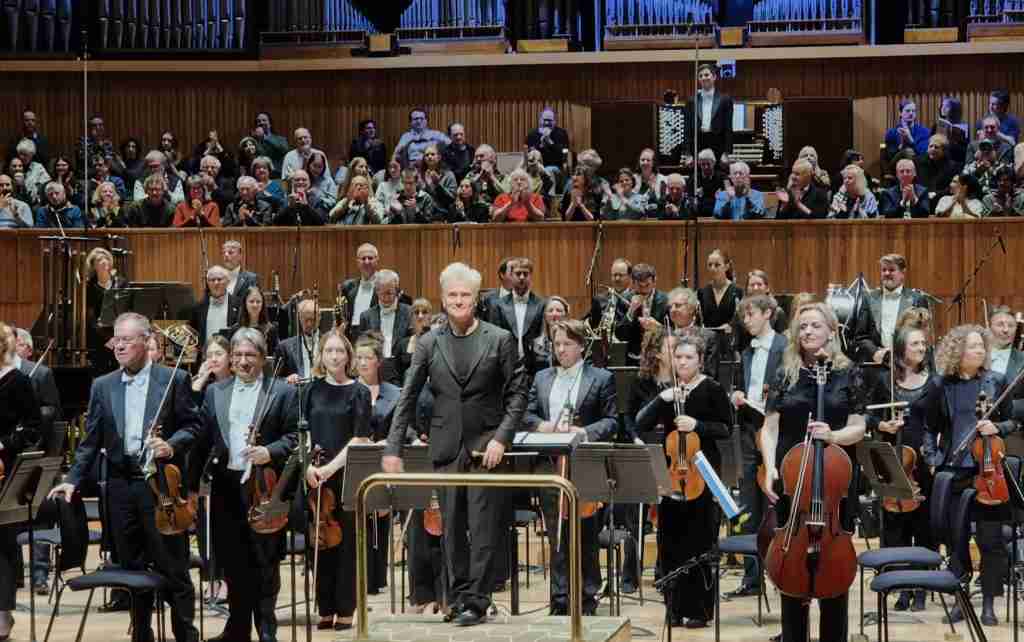
Sofia Gubaidulina, Russian-born but resident in Germany for the last decades of her life, died in March of this year, so it is entirely fitting that a good many recent concerts have paid tribute to her many different styles of composition and extraordinary personal achievements. Soviet Russia knew all about cancel culture: she was blacklisted by the Composers Union, which denounced her music as “noisy mud”, and in 1973 a person believed to have been a KGB operative attempted to strangle her in the elevator of the building where she lived. She managed to scare him off by asking why it was taking so long to kill her. I can’t help thinking that for her music became a kind of personal refuge, a retreat from the brutality of the world around her. Not surprisingly, she made her living in Soviet Russia by composing film music, something her friend and mentor Shostakovich had done before her. This concert given by the London Symphony Orchestra under Ryan Bancroft, marking his debut with all the players, after standing in for a September Prom scheduled to have been conducted by Sir Simon Rattle with all but the strings, began with Gubaidulina’s 1971 composition,
Märchen – Poem
.
Written to accompany a children’s radio play, this fifteen-minute piece is a model of economy, using a small body of strings grounded on just two double basses, with flutes (but no oboes), clarinets (but no bassoons), the absence of brass but celesta, piano, harp and additional percussion. It is very filmic and highly atmospheric, displaying a remarkable ear for aural effects: the rustling of strings and later their anguished cries and those of the woodwind too, an agitated viola solo, an ominous bass clarinet, staccato piano chords acting like gunfire, sonorities which hark back to the world of Stravinsky’s
Petrushka
, and at its close an opulent display of keyboard percussion. Bancroft conducted both spatially and spaciously.
Whenever I hear Shostakovich’s First Violin Concerto, written in the aftermath of the Second World War, I am taken into the world of oppressive darkness, about which this composer knew so much. It is not a work for the faint-hearted, and in this expansive performance featuring Clara-Jumi Kang as soloist you felt every sinew being stretched almost to breaking-point. Indeed, the writing encourages an intensity of bow pressure: during one performance by the work’s dedicatee, David Oistrakh, his E string snapped. Beauty of tone is not a requirement here, and in the opening
Moderato
movement Kang found all the graininess and grit to make this introspective night music come alive. Its restless chromatic harmonies created a constant feeling of instability, of inner disorientation, with the woodwind playing for the most part in their lower registers and heralding a slow descent into the abyss.
The structure of this piece is itself remarkable, the four movements following a strict slow-fast-slow-fast pattern, yet incorporating romantic character pieces such as a nocturne, a scherzo, a passacaglia and a burlesque. Short and snappy sounds predominated in the second movement, Kang’s generous tone even at speed and spit-in-your-face mood matched by the controlled venom exuded by Bancroft and the superbly confident LSO. At the heart of the work is the third movement
Passacaglia
, which unfolded here like a gigantic funeral march, its tread uncompromising, its message bleak and stark. Kang was most impressive at this point, the steel-edged, piercing quality of her upper register contrasting most effectively with the black richness she displayed on the G string. In the five-minute cadenza, introduced by soft timpani rolls, Kang’s face was the picture of concentration, her eyes shut as so often throughout the concerto, the grim implacability of the music underlined by the dissonant double-stopping, acting like a flurry of daggers to the soul. The concluding movement turned into a white-knuckle ride, soloist and orchestra in complete harmony.
Stravinsky very nearly didn’t get the lucky break that was to make him world famous. In his search for a new composition for his Ballets Russes, spotlighting one of the many 19th century Russian folk tales that inspired so much orchestral writing, Diaghilev turned first to Lyadov and then Alexander Tcherepnin before alighting on the young and little-known pupil of Rimsky-Korsakov. The third choice turned into the first rate. Smart businessman that he always was, Stravinsky was adept at producing different suites from his ballet
The Firebird
, but none of them comes anywhere close to the magic and majesty of the full score. We know why this is so rarely performed: it requires huge orchestral forces, here spread out right across the Barbican platform, and including three harps, together with off-stage brass players positioned high up in the back reaches of the hall.
Hear the complete ballet and you realise what a consummate orchestrator and master of colour Stravinsky was. This is very pictorial music, dripping in atmosphere throughout, and wonderfully realised in Bancroft’s energising direction with an LSO on top form. It was a meal and a half. The opening purposeful line of the double basses, sharply delineated, was already edged with dark malice, the growling trombones just about audible. In fact, I very much appreciated the way Bancroft integrated all the woodwind and brass solos into the overall tapestry, rather than highlighting these as virtuosic displays, and the linkages between the individual steps in the narration were handled with a sure sense of pacing. The strings were often light and feathery, like an entire corps de ballet parading a succession of
glissades
and
jetés
, and yet they also had the coruscating power to underpin the sledgehammer chords of the Infernal Dance. In the concluding Lullaby they captured the iridescence of the moment, whispering magically as an introduction to a velvety solo from the principal horn, before adding to the waves of impressive brass-laden sounds at the close. This is highly intoxicating music, intensely addictive, and should strictly speaking come with a health warning.
←
音乐会评论
瑞安·班克罗夫特与伦敦交响乐团首次合作,演出俄罗斯音乐
Sofia Gubaidulina, Russian-born but resident in Germany for the last decades of her life, died in March of this year, so it is entirely fitting that a good many recent concerts have paid tribute to her many different styles of composition and extraordinary personal achievements. Soviet Russia knew all about cancel culture: she was blacklisted by the Composers Union, which denounced her music as “noisy mud”, and in 1973 a person believed to have been a KGB operative attempted to strangle her in the elevator of the building where she lived. She managed to scare him off by asking why it was taking so long to kill her. I can’t help thinking that for her music became a kind of personal refuge, a retreat from the brutality of the world around her. Not surprisingly, she made her living in Soviet Russia by composing film music, something her friend and mentor Shostakovich had done before her. This concert given by the London Symphony Orchestra under Ryan Bancroft, marking his debut with all the players, after standing in for a September Prom scheduled to have been conducted by Sir Simon Rattle with all but the strings, began with Gubaidulina’s 1971 composition,