The Cleveland Orchestra’s annual residency at Miami’s Arsht Center included two weeks of programs led by distinguished guest conductors. I attended a repeat performance of their first program at the Kravis Center in West Palm Beach, and I heard the second program at the Arsht. (The residency will conclude in May with music by Elgar and Holst conducted by Daniel Harding at the Arsht.)
Guest conductor Kahchun Wong led the January 27 program at the Kravis Center. Singapore-born Wong is Chief Conductor of the Japan Philharmonic Orchestra, Principal Conductor and Artistic Advisor of the Hallé Orchestra, and Principal Guest Conductor of the Dresden Philharmonic Orchestra, and has the distinction of being the youngest guest conductor of the New York Philharmonic. Violin soloist Sayaka Shoji was born in Tokyo, raised from age three in Siena, Italy, and received her musical education in Italy and Germany. Since winning the first prize at the Paganini Competition in 1999 she has appeared with leading orchestras around the world, and her recorded output includes sonatas by Mozart and Beethoven as well as concertos by Beethoven, Tchaikovsky, Mendelssohn, Paganini, Prokofiev, Sibelius and Shostakovich.
The program began with Shoji’s superb performance of Beethoven’s Violin Concerto in D, Op.61. Wong’s baton-less conducting style featured large, sweeping gestures, interspersed with occasional small hand movements. He carefully articulated the pervasive four-beat gesture that began on the timpani and was echoed by the strings in the concerto’s opening measures. During the lengthy orchestral introduction Shoji swayed ever so slightly, finally entering with a brief cadenza-like virtuoso passage. She partnered excellently with Wong and the orchestra throughout the opening movement, weaving its thematic elements into a cadenza of her own composition that showed off her dazzling technique. Her 1729 Stradivarius ‘Recamier’ exuded the sweetness called for by Beethoven’s many
dolce
markings, and sang out even more gloriously in the Larghetto, which also featured fine contributions from bassoon, horns and muted strings. In
the exuberant Rondo finale, Shoji was terrific in ornamenting the orchestra’s playing in one variation after another as well as in a second cadenza and the brilliant coda that followed.
After intermission, Wong led a scintillating performance of Modest Mussorgsky’s Pictures at an Exhibition in Maurice Ravel’s brilliant orchestration. Wong conducted from memory – not surprising, since he had himself orchestrated the work in a version for Chinese instruments and orchestra! Principal trumpet Michael Sachs voiced the recurring ‘Promenade’ theme and contributed outstanding solos throughout the work, including his chattering characterization of an impoverished Jew in contrast to the low strings’ representation of his wealthy counterpart in ‘Samuel Goldenberg and Schmuÿle’. Other highlights included the saxophone’s depiction of ‘The Old Castle’, the slowly moving oxcart portrayed by Richard Stout on the euphonium in ‘Bydlo’, the flute and strings in the ‘Ballet of the Unhatched Chicks’, the brass in ‘Catacombs’ and (joined by the percussion) in ‘The Hut of Baba Yaga’. In ‘The Great Gate of Kiev’ the brass sent colossal reverberations through the hall, a reminder of why this is among the most memorable finales in the entire classical repertoire.
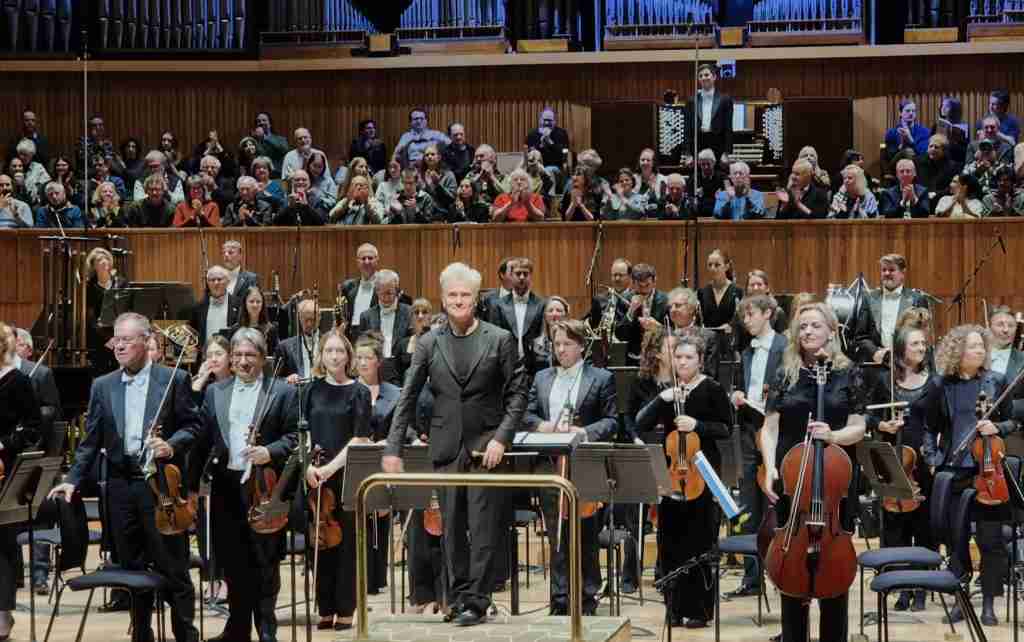
The February 1 concert in the Knight Concert Hall at Miami’s Arsht Center was led by Stéphane Denève, who is the artistic director of the New World Symphony, based in nearby Miami Beach, and music director of the St. Louis Symphony Orchestra. In the first and last works on this program about two dozen New World Fellows joined the Clevelanders.
The concert began with Denève’s own compilation of selections from the two suites from Bizet’s incidental music for L’Arlésienne, the first by the composer himself and the second created after Bizet’s death by his friend, Ernest Guiraud. The opening Carillon is dominated by a persistent figure on the horns with lyrical contributions from winds and strings, including a delicate interlude beautifully played by principal flute Joshua Smith and a small string cohort. Muted strings (minus the basses) were gorgeous in the Adagietto, and Denève brought out the dancelike character of the Menuetto. A duet by Smith on flute and Trina Struble on harp gave the Minuet (borrowed from Bizet’s opera, The Fair Maid of Perth) a characteristically French air. In the Farandole, with the strings above and the brass and winds below playing contrasting melodies, the entire augmented orchestra was at top volume to provide a rousing finale.
Violinist Maria Dueñas is a rising star at just 22 years old. She already is a frequent soloist with many of the world’s great orchestras as well as a chamber music partner with leading artists, and she has an exclusive recording contract with Deutsche Grammophon. In Edouard Lalo’s Symphonie espagnole – which despite its title is a five-movement violin concerto – she called on her Andalusian heritage to bring out the work’s variety of Spanish dance rhythms. From the brilliant opening measures onward, Dueñas tossed off pyrotechnic challenges with apparent ease while eliciting beautiful tone in both high and low registers from her three-hundred-year-old Nicolò Gagliano instrument. In the opening Allegro non troppo she offered both lyrical melodies and rapid figurations, and in the Scherzando she intoned sweetly as Denève and the orchestra supplied a
seguidilla
rhythmic underpinning. In the Intermezzo Dueñas showed off her instrument’s low register and then gave a dazzling sequence of rapid trills and flashy bowing, ending with
pizzicato
notes and a surprising big orchestral chord. The Andante struck a more serious tone and Dueñas’s playing was appropriately heartfelt. The Rondo finale, with the violin playing a catchy theme against an orchestral
ostinato
figure, brought the work to a delightful conclusion. Dueñas offered Aleksey Igudesman’s ‘Applemania’ as an encore, showing off her spectacular bowing skill.
The concert concluded with a richly satisfying performance of Dvořák’s Eighth Symphony, Opus 88. Beginning with lush cellos, low winds and horns playing a stately, minor-mode theme, it does not arrive at its home key of G-major until the flute intones a bright theme – just the first of the opening movement’s harmonic and melodic surprises. Denève and the orchestra captured the spirit of Czech folk music in a succession of mostly cheerful tunes. The movement ends in high spirits, capped off with drumbeats, whooping horns and trumpets. In the ensuing Adagio, the winds’ contributions were much darker, with horns and timpani providing bass-line support. The Allegretto grazioso is a
furiant
, with whirling strings and a Trio that featured a lovely solo by principal oboist Frank Rosenwein. Sachs’s trumpet fanfare heralded the Allegro ma non troppo finale, with the cellos introducing the principal theme that underwent numerous variations, affording opportunities for the entire orchestra to shine. Denève masterfully controlled tempos, phrasing and dynamics, but pulled out all the stops in a mad dash to an exciting finish.
←
音乐会评论
Stéphane Denève 摄影:TCO
The Cleveland Orchestra’s annual residency at Miami’s Arsht Center included two weeks of programs led by distinguished guest conductors. I attended a repeat performance of their first program at the Kravis Center in West Palm Beach, and I heard the second program at the Arsht. (The residency will conclude in May with music by Elgar and Holst conducted by Daniel Harding at the Arsht.)